

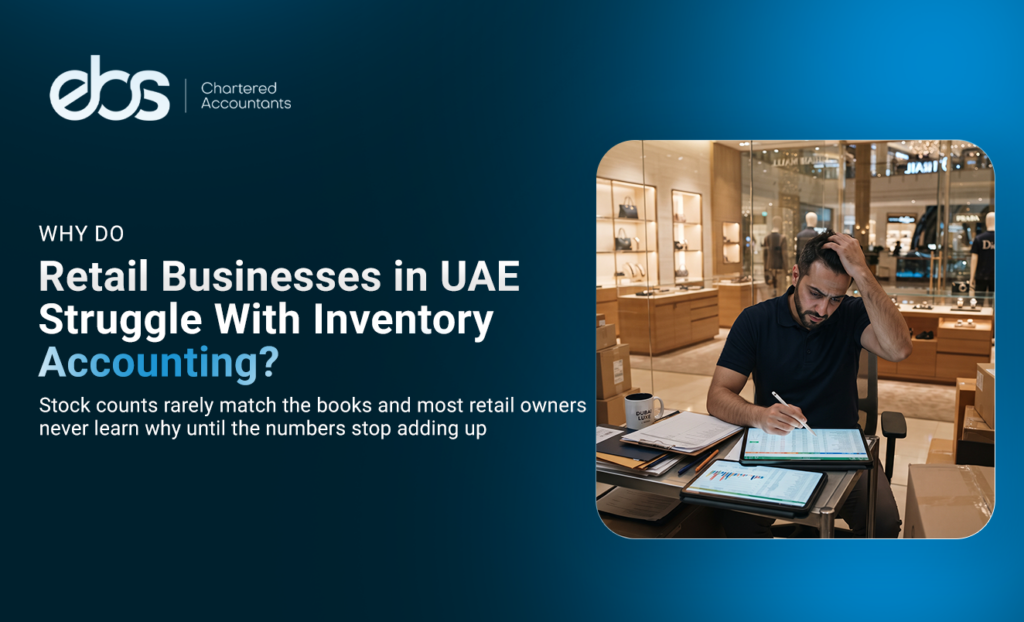
A shop counts its physical stock at year-end and finds three hundred units sitting on the shelf that the accounting system insists should not exist. Nobody stole anything. Nobody made an obvious mistake. The gap simply grew quietly over twelve months of sales returns damaged goods and a valuation method nobody revisited since the business opened. Retail inventory accounting in UAE businesses actually run on paper rarely matches what sits on the shelf and the gap is almost never due to fraud. It is almost always due to a system nobody built to keep up with how fast stock actually moves.
At ebs chartered accountants we see this exact mismatch constantly in retail inventory accounting in UAE engagements when a client comes to us for the first time. The sales figures look fine. The stock figures tell a different story nobody has reconciled in months.
Which Inventory Valuation Method Suits UAE Retail Businesses?
Under IAS 2 the accounting standard governing inventory valuation in Dubai and wider UAE rules a business generally chooses between weighted average cost and FIFO first in first out. LIFO is not permitted under IFRS which catches out retailers who learned their accounting in a market that allows it.
| Method | How It Works | Best Suited To |
| Weighted average cost | Averages the cost of all units held updated as new stock arrives | High volume retail with frequently mixed stock batches |
| FIFO | Assumes the oldest stock is sold first | Perishables or stock sensitive to obsolescence |
Inventory valuation retailers rely on tends to favour weighted average cost simply because most shops cannot practically track which specific physical unit from which specific delivery was sold to which specific customer. FIFO suits businesses where stock genuinely needs to move in the order it arrived such as food retail or anything with an expiry date.
Quick tip. Pick one inventory valuation method in Dubai and apply it consistently across an entire product category rather than switching between methods whenever it seems to flatter a particular month’s margin. Inconsistent application is one of the fastest ways to fail an audit review.
How Should Shrinkage and Stock Write-Offs Be Recorded?
Shrinkage covers the inventory that disappears between what the system says should exist and what physically remains whether through theft damage administrative error or simple miscounting a recurring issue in retail inventory accounting that UAE businesses face. It needs to be recorded as a specific cost rather than quietly absorbed into the cost of goods sold where it distorts the real margin picture.
A proper write-off under inventory valuation in UAE rules reduces the recorded inventory value and records a corresponding expense ideally tagged clearly enough that an owner can see shrinkage as its own line rather than buried inside the overall cost of sales. Our team at ebs chartered accountants regularly finds retail clients who have never separated shrinkage from ordinary cost of goods at all which means a growing theft or damage problem can hide inside what looks like a perfectly normal margin for years before anyone notices the pattern.
How Does Inventory Accounting Affect VAT and Margins?
Inventory valuation in Dubai businesses directly shapes the cost of goods sold and cost of goods sold directly shapes reported gross margin. Get the valuation wrong and every margin figure built on top of it is wrong too even though the actual cash in the bank never changed.
VAT adds a further layer and this is exactly the connection accounting and bookkeeping services in Dubai are trained to manage across the whole process. Retail inventory accounting businesses handle stock movement cost of goods sold and VAT as three connected pieces rather than three separate problems solved in isolation because a mistake in one almost always shows up as a distortion in another.
Why Does This Go Wrong So Often in Growing Retail Businesses?
The honest pattern we see across accounting and bookkeeping services in UAE is that this setup works fine when a business is small enough that an owner can mentally track every item. It breaks the moment a business adds a second location a wider product range or simply enough volume that nobody can hold the full picture in their head anymore.
A business that never updates its inventory valuation process in Dubai as it grows ends up running a system built for twenty products on one shelf when it now carries two thousand and the gap between reality and the books widens every single month if accounting and bookkeeping services are not involved. This is the exact moment many retailers finally reach out for help with inventory valuation rules usually right after a stock count has revealed a discrepancy nobody can explain.
How Can Accounting and Bookkeeping Services in Dubai Help Fix Inventory Problems?
Professional accounting and bookkeeping services bring structure to a process most growing retailers have outgrown without realising it. This typically starts with choosing a valuation method that genuinely fits the business rather than whatever was set up on day one and never revisited.
From there proper processes build in regular stock counts reconciled against the system, a clear separate line for shrinkage rather than letting it hide inside margin and VAT treatment that correctly reflects what actually happened to each once-a-year-aged or returned stock. Working with the right partner on this turns inventory from a once-a-year panic during stocktake into a number an owner can actually trust every single month and accounting and bookkeeping services exist precisely to catch this before it compounds.
Frequently Asked Questions
Under inventory valuation in Dubai and wider UAE rules, weighted average cost suits most high-volume retail since tracking individual units is impractical. FIFO works better for stock that goes bad or loses value quickly.
Good retail inventory accounting in UAE practice records shrinkage as its own distinct cost rather than absorbing it into the general cost of goods sold so the real margin and the scale of any loss stay visible.
Businesses directly apply the cost of goods sold and reported margin while the treatment of damaged or written-off stock can also affect input VAT recovery depending on circumstances.
Yes, and this is one of the most common findings accounting and bookkeeping services teams encounter during a first review.