

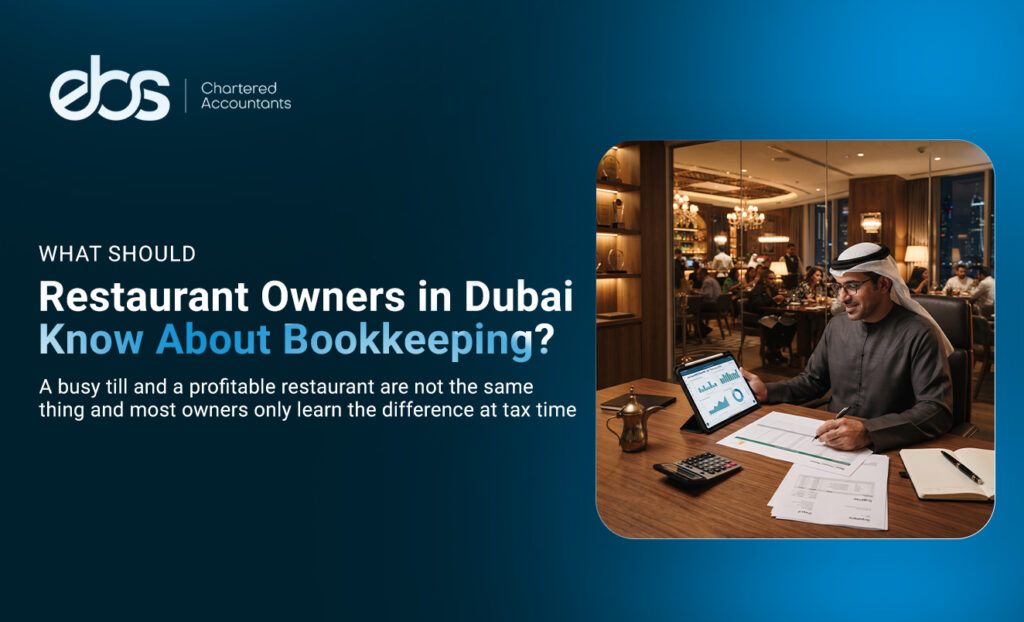
Most restaurant owners count the till at closing and call that bookkeeping. It is a start but it tells you almost nothing about whether the business made money that day. Restaurant bookkeeping in Dubai has to follow a sale all the way from the customer’s table to the bank account and the VAT return. Every step in between is a place where money quietly goes missing.
At ebs chartered accountants we are one of the accounting and bookkeeping services in Dubai that restaurant owners call after a good month still leaves the bank balance short. The kitchen is busy and the tables are full. The numbers just do not add up the way the owner expects.
What Does Good Restaurant Bookkeeping Actually Look Like Day to Day?
Good restaurant bookkeeping in Dubai looks like a short routine done at every closing and never skipped. One person counts the cash and another signs off. The till report is compared with the card terminal report and the delivery platform dashboard. Anything that does not match is written down that night while the staff who handled it still remember what happened.
F&B accounting in UAE works best when this daily close is part of the job and not paperwork for later. A good close covers a few fixed steps.
- Cash count. Count the drawer and compare it with the till report. Record any difference and who counted.
- Card sales. Match terminal totals to the till so no card sale is missing or counted twice.
- Delivery orders. Record platform sales separately from dine-in sales.
- Wastage and comps. Log spoiled food and free items so they do not hide inside cost of sales.
Card money does not reach the bank on the day of the sale. It arrives days later and net of fees. Our team sees owners treat a bank deposit as the day’s sales when it is really a mix of several earlier days minus charges. Reliable accounting and bookkeeping services in Dubai reconcile card settlements to sales so that gap is visible instead of confusing.
Why Does a Busy Restaurant Still Run Out of Cash?
Because sales and cash are not the same thing. A restaurant pays suppliers and staff and rent on fixed dates while customers and delivery platforms pay on their own schedule. Strong F&B accounting in UAE tracks that timing so the owner can see a shortage coming weeks ahead and not on the day payroll is due.
Quick tip. Run a simple weekly cash view that lists money due in from card settlements and platform payouts and money due out to suppliers and payroll. This one habit makes restaurant bookkeeping in UAE useful for decisions and not just for filing.
How Do You Know If Your Menu Is Making or Losing Money?
Food cost is the first number to check in food and beverage accounting. It is the cost of ingredients used divided by food sales for the same period. A commonly used industry rule of thumb puts healthy food cost somewhere around the late twenties to mid-thirties as a percentage of food sales but the right figure depends on the concept and the menu. The real value of F&B accounting in UAE is comparing your own figure week by week and finding out why it moved.
That comparison only works if stock is counted and purchases are matched to invoices. A weekly stock count is basic F&B bookkeeping and it takes little time. It shows quickly whether waste or over-portioning or theft is behind a rising food cost. At ebs chartered accountants we often find the cost problem sits in two or three dishes and not across the whole menu. Good accounting and bookkeeping services in Dubai turn the stock count into a per-dish view of where margin leaks.
What Changes in the Books When Delivery Apps Bring in Orders?
Delivery changes three things. The money arrives from a platform and not the customer. The platform keeps a commission. And VAT now sits on both the food sale and the commission. Restaurant bookkeeping in Dubai needs each of these recorded on its own line so sales are not understated by the amount the platform keeps.
| Item | Typical Treatment |
| Food sold to the customer | Standard-rated at 5% VAT |
| Platform commission | VAT is charged to the restaurant and is generally recoverable as input VAT |
| Customer delivery fee | Treatment depends on who provides the delivery under the contract |
| Platform payout | Arrives net of commission so record the full sale and the commission separately |
Who is treated as the supplier of the food can depend on how the contract with the platform is written. That is the point where owners should read the agreement and not assume. Our team reviews these contracts for F&B accounting in UAE clients so each stream is taxed the right way. Treatment can change so confirm the current position with the Federal Tax Authority.
Which Records Should a Restaurant Keep for Tax and Audit?
Keep daily till reports and card settlement statements and delivery platform statements and supplier invoices and stock count sheets and payroll records. Tax invoices for purchases support the VAT a restaurant reclaims. Organised accounting and bookkeeping services in Dubai keep these in order so a VAT review or an audit becomes a routine request and not a scramble. Clean records are the base of F&B accounting in UAE.
These records also protect the owner in a dispute with a supplier or a staff member. Complete restaurant bookkeeping in Dubai answers most questions in minutes. Missing months of statements cannot be recovered.
Why Do Restaurant Owners Hand the Books to Accounting and Bookkeeping Services in Dubai?
Because an owner’s best hours belong in the restaurant and not in a spreadsheet at midnight. A specialist team from accounting and bookkeeping services already knows the daily close and the card settlement lag and the delivery platform rules. Restaurant accountants in Dubai who work only with hospitality spot a rising food cost or a missing settlement faster than a generalist can. That is what makes F&B accounting in UAE a different skill from ordinary bookkeeping.
At ebs chartered accountants we set up the daily close and the weekly cash view first and then the monthly reports. Within a few cycles the owner stops guessing and starts reading. Contact us and get your restaurant books checked.
Frequently Asked Questions
Count the cash against the till report every night and match card terminal totals to the till. Reconcile card settlements to the bank when they arrive, since they may land days later and are usually net of fees.
A common industry rule of thumb is roughly the late twenties to mid-thirties as a percentage of food sales, but it varies by concept and menu. Good F&B accounting in the UAE benchmarks your own figure over time rather than relying on a generic number.
Food sales are generally standard-rated at 5%, while the platform commission carries VAT that is generally recoverable. Treatment can depend on the contract, so confirm the details with the Federal Tax Authority or an accounting and bookkeeping service provider in Dubai.
Yes. Keeping separate records helps show the true margin for each sales channel after commissions and makes VAT treatment easier to track and verify.