

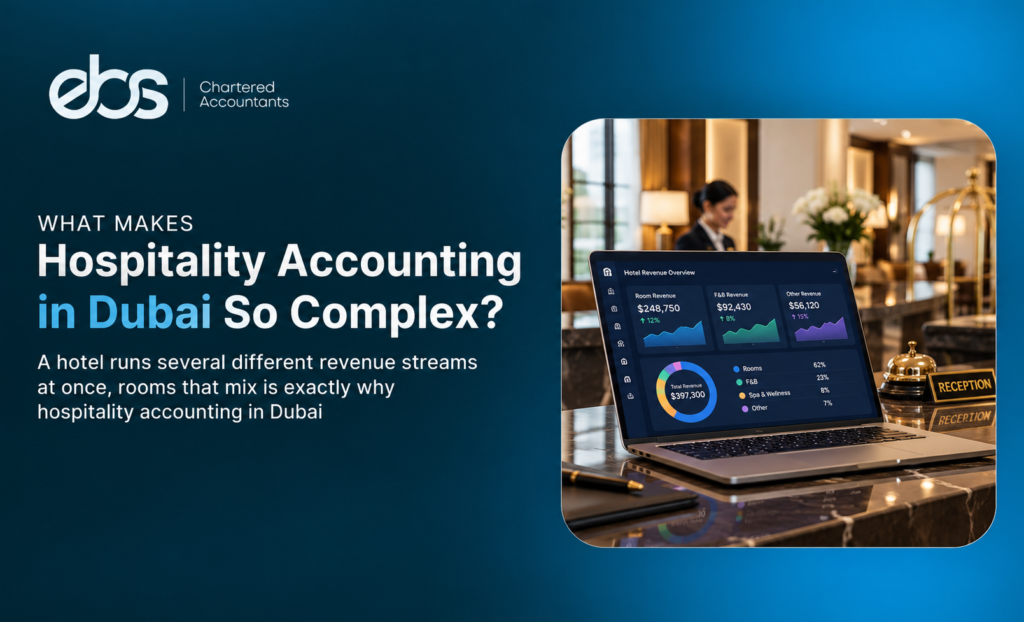
A hotel books a guest for a five-night stay paid upfront runs a restaurant tab that gets settled nightly and adds a service charge that half the staff assumes is a tip and the other half assumes is revenue. By the time the monthly close happens three different departments have recorded three different versions of what actually happened. Hospitality accounting in UAE breaks more often at this exact point than anywhere else.
The mistake we see most often in hospitality accounting is a hotel applying standard retail accounting logic to a business that genuinely does not work that way. A shop sells a product once. A hotel sells a room tonight a breakfast tomorrow and a wedding six months from now often to the same guest and often paid for in three different transactions at three different times.
What Revenue Recognition Issues Are Unique to UAE Hospitality?
The core problem is timing. A guest pays for a stay in advance but the revenue is not actually earned until each night is delivered. Hotel accounting in UAE has to split that upfront payment across the nights it covers rather than booking the full amount the moment cash lands.
Hotel accounting in UAE gets messier with packages and bundles. A stay that includes breakfast spa credit and an airport transfer is not one revenue line. It is several each recognised on its own schedule and often at a different margin.
| Revenue Type | When It Should Be Recognised |
| Room revenue | Spread across each night stayed |
| Food and beverage | On the night the meal is served |
| Advance deposits | Held as a liability until the stay occurs |
| Package add-ons (spa, transfers) | Recognised when the service is actually delivered |
| Banquet and event bookings | Recognised on the event date, not the booking date |
An accounting consultancy in Dubai will confirm that a property booking an advance deposit straight to revenue is overstating its position the moment the guest has not yet checked in. This single habit is the one we correct most often when we take on a new hospitality accounting in Dubai client.
How Should Service Charges and Tips Be Accounted For?
This is one of the areas where hospitality accounting in Dubai gets genuinely confusing for staff and finance teams alike. A mandatory service charge added to a bill is not the same thing as a voluntary tip and treating them identically causes real problems at year end. Under hotel accounting in UAE a service charge collected by the business and later distributed to staff is generally treated as a liability owed to employees rather than revenue the business keeps.
A voluntary tip left directly for a server may sit entirely outside the company’s books if it never passes through the till. The properties that get this wrong tend to record the service charge as income first and the staff payout as an expense second. This inflates revenue in a way that misrepresents what the hotel actually earned versus what it merely collected and passed through.
Quick tip. Any accounting consultancy will tell you to keep service charge collections and distributions in a dedicated liability account from day one. Fixing a year’s worth of mixed up records later is much harder than doing it right from the start.
What VAT Rules Apply to Hotel and Restaurant Billing?
Hotel and restaurant services generally attract the standard 5% VAT rate. Where hotel accounting in UAE gets more layered which is the additional municipality and tourism-related fees many properties apply on top of the room rate. These are separate from VAT and need to be itemised and treated correctly rather than folded into one figure.
Because these additional fees and their exact current rates can be updated separately from VAT itself a property should confirm the current structure with an accounting consultancy in Dubai rather than relying on last year’s invoice template. Mixing VAT with a municipality fee on the same line is a common billing error under hotel accounting that complicates both guest invoicing and the property’s own VAT return.
Why Does Hospitality Accounting in Dubai Need Specialist Attention?
Generalist bookkeeping habits fail hospitality accounting clients in specific and repeatable ways. A restaurant that closes its till nightly but only reconciles its books monthly loses the ability to catch a discrepancy while the shift staff who caused it are still around to ask. A hotel running loyalty points or gift vouchers needs those tracked as a genuine liability until redeemed. This is something a standard retail chart of accounts rarely handles cleanly out of the box.
An accounting consultancy in Dubai will confirm that the properties staying accurate are the ones building their chart of accounts around how a hotel actually operates rather than adapting a generic template. Room revenue food and beverage banquet income and ancillary services each need their own visibility rather than being blended into one undifferentiated sales figure that tells an owner almost nothing useful about where the money actually comes from. This is exactly why hospitality accounting in Dubai deserves treatment as its own discipline rather than a variant of retail bookkeeping.
How Can an Accounting Consultancy in Dubai Support Hospitality Businesses?
An accounting consultancy familiar with hospitality specifically brings a chart of accounts already built around how hotels and restaurants actually earn revenue rather than starting from a blank retail template and hoping it fits. This alone saves months of restructuring later. This kind of support typically covers setting up proper revenue recognition across rooms food and beverage and events separately.
It also means structuring service charge and tip handling correctly from day one and confirming VAT and municipality fee treatment matches the current requirements rather than an outdated invoice format. Working with an accounting consultancy in UAE that understands hotel accounting in UAE specifically turns a business with five overlapping revenue streams into one set of books an owner can actually trust. Talk to ebs chartered accountants today.
Frequently Asked Questions
Under hotel accounting in UAE, advance payments should be spread across the nights they cover rather than booked immediately. Package bundles also need to be split into separate revenue lines and recognised according to their applicable schedules.
Good hospitality accounting treats mandatory service charges collected by the business as a liability owed to staff rather than revenue, while voluntary tips may sit entirely outside the company’s books.
Hotel and restaurant services generally attract the standard 5% VAT rate, with additional municipality or tourism-related fees treated separately and itemised rather than added into one figure.
Yes. Unredeemed loyalty points and gift vouchers should be tracked as a liability until they are used, as they represent an obligation to provide future value to the guest.