

The UAE is entering a decisive new phase in tax and digital compliance with the nationwide rollout of Electronic invoicing (E-Invoicing). What began as a strategic modernization initiative has now evolved into a mandatory compliance framework, supported by legislation, defined timelines, and administrative penalties for non-compliance.
From large taxpayers participating in the 2025 pilot phase to SMEs preparing for the UAE E-Invoicing mandate 2026, E-Invoicing is no longer optional. This guide will delve into everything UAE businesses need to know; scope, requirements, timelines, penalties, misconceptions, and preparation into one clear roadmap.
What Is UAE E-Invoicing?
UAE E-Invoicing refers to the electronic issuance, transmission, and reporting of invoices through a government-approved UAE Electronic Invoicing System (EIS).
Unlike traditional paper or PDF invoices, compliant e-invoices must be:
- Structured and machine-readable (XML or JSON)
- Generated and transmitted electronically
- Validated via an Accredited Service Provider (ASP)
The EIS is designed to integrate invoicing directly with VAT and Corporate Tax compliance, enabling real-time or near-real-time reporting to the Federal Tax Authority (FTA).
The Legal Framework: What Changed?
The UAE has now established a clear and enforceable legal foundation for E-Invoicing.
1. Federal Decree-Law No. 16 of 2024
This amendment to the VAT Law officially recognizes:
- Electronic invoices
- Electronic tax credit notes as legally valid documents in digital format.
2. Cabinet Resolution No. 106 of 2025
Issued in December 2025, this resolution introduces a formal penalty framework for UAE E-Invoicing compliance & penalties, reinforcing enforcement under the phased rollout.
Together, these regulations signal the UAE’s shift toward full digital tax transparency and the end of informal invoicing practices.
UAE E-Invoicing Timeline: 2025 to 2027
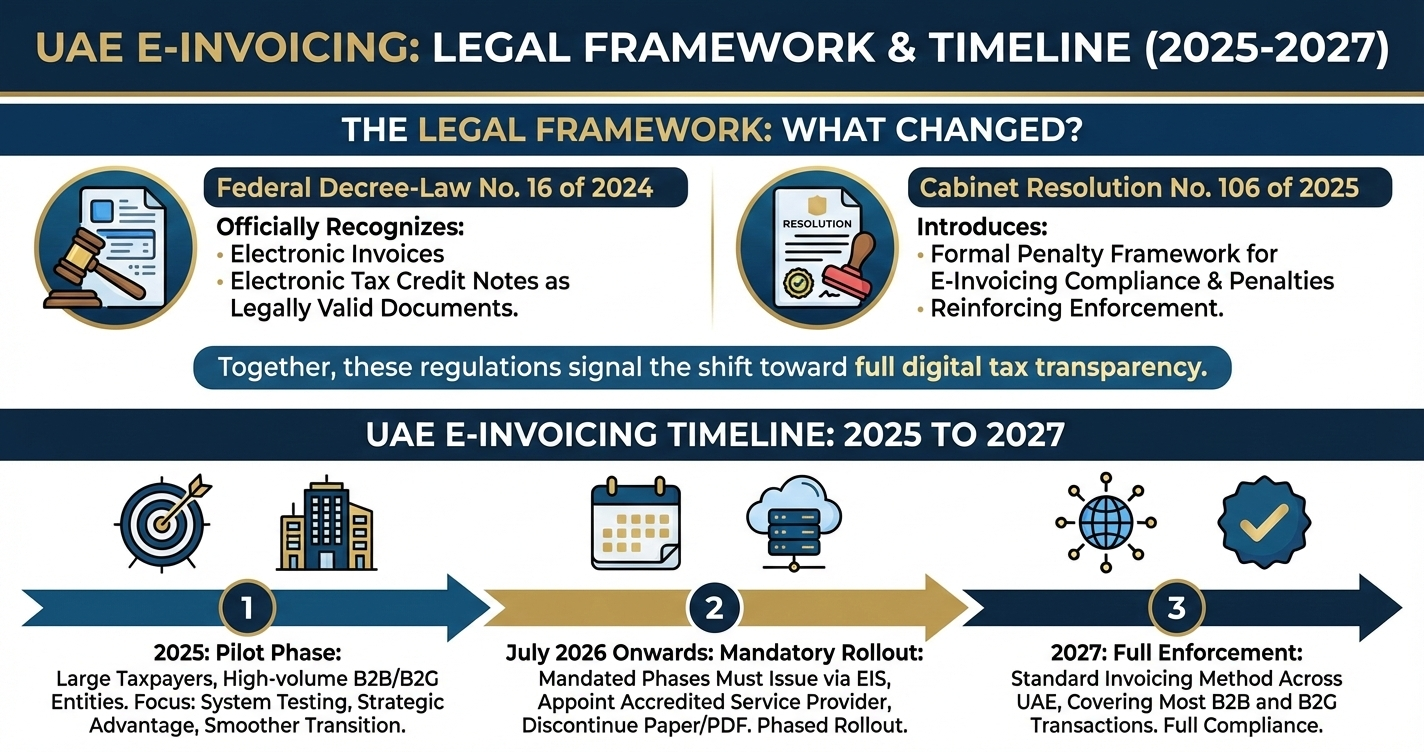
2025: Pilot Phase (Large Taxpayers)
The UAE launched an E-Invoicing pilot program targeting:
- Large taxpayers
- High-volume B2B and B2G entities
- Corporations with complex tax profiles
Why early adoption matters:
- Smoother transition before enforcement
- System testing without penalty exposure
- Strategic compliance advantage
- Reduced billing and cash-flow disruption
July 2026 Onwards: Mandatory Rollout
From July 2026, businesses included in the mandated phases must:
- Issue invoices exclusively through the EIS
- Appoint an Accredited Service Provider
- Discontinue paper or PDF invoices for covered transactions
The rollout will be phased, with official notices issued by authorities.
2027: Full Enforcement
By 2027, E-Invoicing is expected to become the standard invoicing method across the UAE, covering most B2B and B2G transactions.
Scope: Who Must Comply?
The UAE E-Invoicing requirements apply to:
- VAT-registered businesses
- Entities issuing B2B or B2G invoices
- Businesses required to issue tax invoices or credit notes
This includes:
- Large corporations
- SMEs
- Free zone entities
- Mainland businesses
Business size does not exempt you. If you issue invoices in the UAE, preparation is mandatory.
Common Misconceptions About UAE E-Invoicing
Despite regulatory clarity, misconceptions remain:
Misconception 1: PDF invoices are e-Invoices
PDFs are not compliant. Only structured, machine-readable formats qualify.
Misconception 2: This only applies to large companies
All invoicing businesses will be impacted through phased enforcement.
Misconception 3: I can comply later without risk
Once your phase goes live, penalties apply immediately.
Misconception 4: My ERP alone is enough
An Accredited Service Provider is mandatory for transmission.
Understanding these early prevents costly errors.
Administrative Penalties Under UAE E-Invoicing
In December 2025, the Ministry of Finance announced Cabinet Resolution No. 106 of 2025, setting out administrative fines for non-compliance with the UAE Electronic Invoicing System (EIS).
The resolution applies to all entities required to implement E-Invoicing under Ministerial Decision No. 243 of 2025. Businesses adopting E-Invoicing voluntarily are exempt until they become mandatorily subject.
Key Penalties
- AED 5,000 per month for failing to:
- Implement the EIS
- Appoint an approved ASP within the specified timeframe
- Implement the EIS
- AED 100 per electronic invoice not issued or transmitted on time
(capped at AED 5,000 per month)
- AED 100 per electronic credit note not issued or transmitted on time
(capped at AED 5,000 per month) - AED 1,000 per day for failing to notify the FTA of system malfunctions
- AED 1,000 per day for failing to notify the ASP of changes to registered business data
E-Invoicing compliance is now directly linked to VAT risk, corporate tax audits, and financial penalties.
What Businesses Must Do Before 2026
Preparation is strategic; not optional.
1. Audit Your Invoicing Systems
- Review ERP, accounting, and billing software
- Identify upgrade or integration gaps
2. Appoint an Accredited Service Provider
- Only ASPs can transmit invoices to authorities
- Early onboarding avoids last-minute risks
3. Shift to Structured E-Invoices
- XML or JSON formats only
- No paper or PDF fallback
4. Train Finance & Billing Teams
- Compliance workflows
- Reporting deadlines
- Error handling procedures
5. Integrate VAT & Corporate Tax Reporting
E-Invoices directly support:
- VAT filings
- Corporate tax calculations
- Audit readiness
6. Test Before Enforcement
Early testing ensures:
- Business continuity
- Zero go-live disruption
- No penalty exposure
Why UAE E-Invoicing Matters Beyond Compliance
E-Invoicing is more than a legal obligation; it’s a business enabler.
Key benefits include:
- Greater transparency and traceability
- Reduced invoicing errors
- Real-time tax reporting
- Faster VAT recovery
- Improved audit readiness
- Scalable systems for growth, M&A, and global expansion
Final Thoughts: Act Now, Not Later
The shift to UAE E-Invoicing is real, mandatory, and enforceable. While 2026 may seem distant, penalties are already defined, and preparation takes time.
Every business must act now to:
- Avoid fines
- Protect tax compliance
- Modernize operations
- Strengthen governance
With the right planning and expert guidance, E-Invoicing becomes a competitive advantage not a burden.
How ebs Chartered Accountants Can Assist?
Transitioning to UAE E-Invoicing requires more than just system upgrades; it demands a clear understanding of regulatory requirements, tax integration, and operational readiness. ebs Chartered Accountants in Dubai provide end-to-end support to help businesses comply with the UAE Electronic Invoicing System (EIS) efficiently and confidently. With over 15 years of experience in UAE tax and compliance, ebs supports businesses at every stage of the E-Invoicing journey by:
- Assessing your current invoicing, ERP, and accounting systems to identify compliance gaps with UAE E-Invoicing requirements
- Advising on system architecture and EIS readiness, ensuring alignment with VAT and Corporate Tax obligations
- Assisting in the selection and onboarding of Accredited Service Providers (ASPs) approved by the authorities
- Managing system integration and testing, including ERP, billing, and accounting software
- Training finance and billing teams on new E-Invoicing workflows, reporting timelines, and error handling
- Coordinating VAT returns, Corporate Tax filings, and EIS reporting within a unified compliance framework
- Monitoring regulatory updates, implementation phases, and deadlines to ensure continuous compliance and avoid penalties
Whether you are a large taxpayer preparing for early adoption or an SME gearing up for the UAE E-Invoicing mandate 2026, ebs ensures a smooth, penalty-free transition while minimizing operational disruption.
By partnering with ebs Chartered Accountants, businesses can turn E-Invoicing from a compliance challenge into an opportunity to strengthen financial controls, enhance transparency, and build long-term tax confidence.
FAQs
1. When will E-Invoicing become mandatory in the UAE?
E-Invoicing in the UAE becomes mandatory in phases starting July 2026, following the 2025 pilot phase for large taxpayers and selected entities.
2. Are PDF invoices allowed under UAE E-Invoicing rules?
No. From the mandate, businesses must issue structured, machine-readable e-invoices (XML/JSON). PDF and paper invoices will not be compliant.
3. What are the penalties for non-compliance with UAE E-Invoicing?
Businesses may face Dh5,000 monthly fines for failing to implement the EIS or appoint an ASP, plus Dh100 per non-compliant invoice (capped monthly).
4. Do SMEs and free zone companies need to comply with E-Invoicing?
Yes. All VAT-registered businesses, including SMEs and free zone entities issuing B2B or B2G invoices, must comply as per the phased rollout.