

Running a small business in Dubai means making smart financial choices. One big decision is how you handle your books. Should you hire an in-house bookkeeper? Or should you work with accounting firms in Dubai? This choice matters more in 2025 than ever before. UAE’s corporate tax is now active. VAT compliance rules are getting stricter. As a result, accurate bookkeeping isn’t optional anymore, it’s essential for survival. Whether you are a startup or growing SMEs, you need professional bookkeeping without breaking the bank. The wrong choice drains resources. The right choice gives you clarity, confidence, and freedom to grow.
Let’s compare both options with real numbers and practical examples.
What Is Outsourced Bookkeeping in Dubai?

Outsourced bookkeeping means hiring an external firm to manage your financial records. Instead of putting someone on your payroll, you engage specialists who work remotely or visit your office as needed. These providers handle several key tasks. They record daily transactions. They reconcile bank accounts. They manage accounts payable and receivable. They prepare financial statements. They file VAT returns. They also ensure corporate tax compliance. Most arrangements work on a monthly retainer. Costs scale based on your transaction volume. This makes pricing flexible and predictable.
What Is In-house Bookkeeping?
In-house bookkeeping means hiring your own employee. This person works exclusively for your company. They handle daily financial tasks from within your organization. Your in-house bookkeeper manages ledgers. They process invoices. They prepare basic reports. They work under your direct supervision. Therefore, they’re immediately available when you need them. However, this arrangement comes with hidden costs. You pay their salary. You cover visa fees. You provide health insurance. You also need office space and equipment.
The Real Cost Comparison
Numbers tell the complete story. Let’s break down what each option actually costs.
Monthly Cost Breakdown
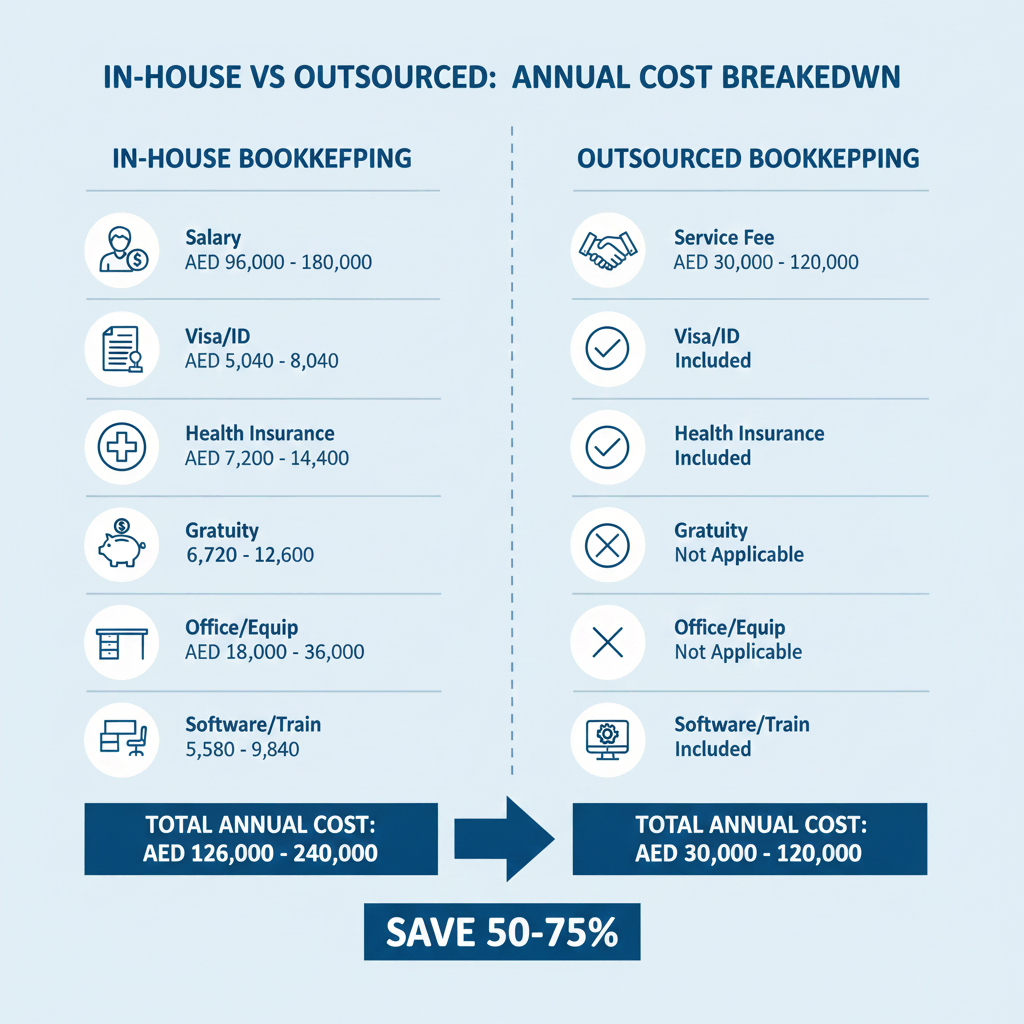
The savings are clear. Outsourcing cuts costs by 50-75% compared to hiring in-house. For startups, this difference matters significantly. Moreover, these figures don’t include recruitment costs. They also don’t account for employee turnover. When your bookkeeper leaves, you repeat the entire hiring process.
UAE Compliance: What You Must Know in 2025
Compliance has become more complex. Both approaches must meet strict requirements. However, the expertise needed has increased dramatically.
Corporate Tax Requirements
UAE introduced corporate tax in June 2023. Federal Decree-Law No. 47 of 2022 created new obligations. Businesses now pay 9% tax on income exceeding AED 375,000. Your bookkeeping must support these requirements:
| Requirement | What It Means | Risk of Non-Compliance |
| Complete financial records | All transactions documented with proof | AED 10,000 – 50,000 penalties |
| Standard accounting format | Following accepted accounting principles | Tax assessment challenges |
| Timely tax returns | Filing within 9 months of year-end | AED 500 – 50,000 fines plus interest |
| FTA registration | Registering with Federal Tax Authority | Business operations suspended |
| Accurate calculations | Correct taxable income and deductions | Penalties and tax adjustments |
A single mistake triggers penalties. Your accountant in Dubai must understand these rules completely.
VAT Record-Keeping Standards
VAT-registered businesses face strict documentation rules. You must keep records for five years minimum. This isn’t optionalit’s legally required. Furthermore, records must include tax invoices. They must show import documentation. They must contain bank statements. Missing records attract AED 10,000 penalties for first offenses.
Economic Substance Regulations
Certain business activities trigger ESR requirements. These include holding companies and IP businesses. Consequently, detailed financial reporting becomes mandatory.The question becomes important: Does your current bookkeeper understand these complex regulations?
Expertise: What You’re Really Getting
Quality matters more than cost. Let’s compare what each option delivers.
In-house Bookkeeper Skills
| Expertise Area | Typical In-house Capability |
| Qualifications | Basic to intermediate accounting knowledge |
| Software Skills | Familiar with 1–2 platforms only |
| UAE Tax Knowledge | General understanding, limited depth |
| Business Exposure | Experience from 2–5 previous employers |
| Professional Updates | Requires paid training for new regulations |
| Chartered Accountant Status | Rarely qualified as CA |
| Audit Experience | Usually limited or none |
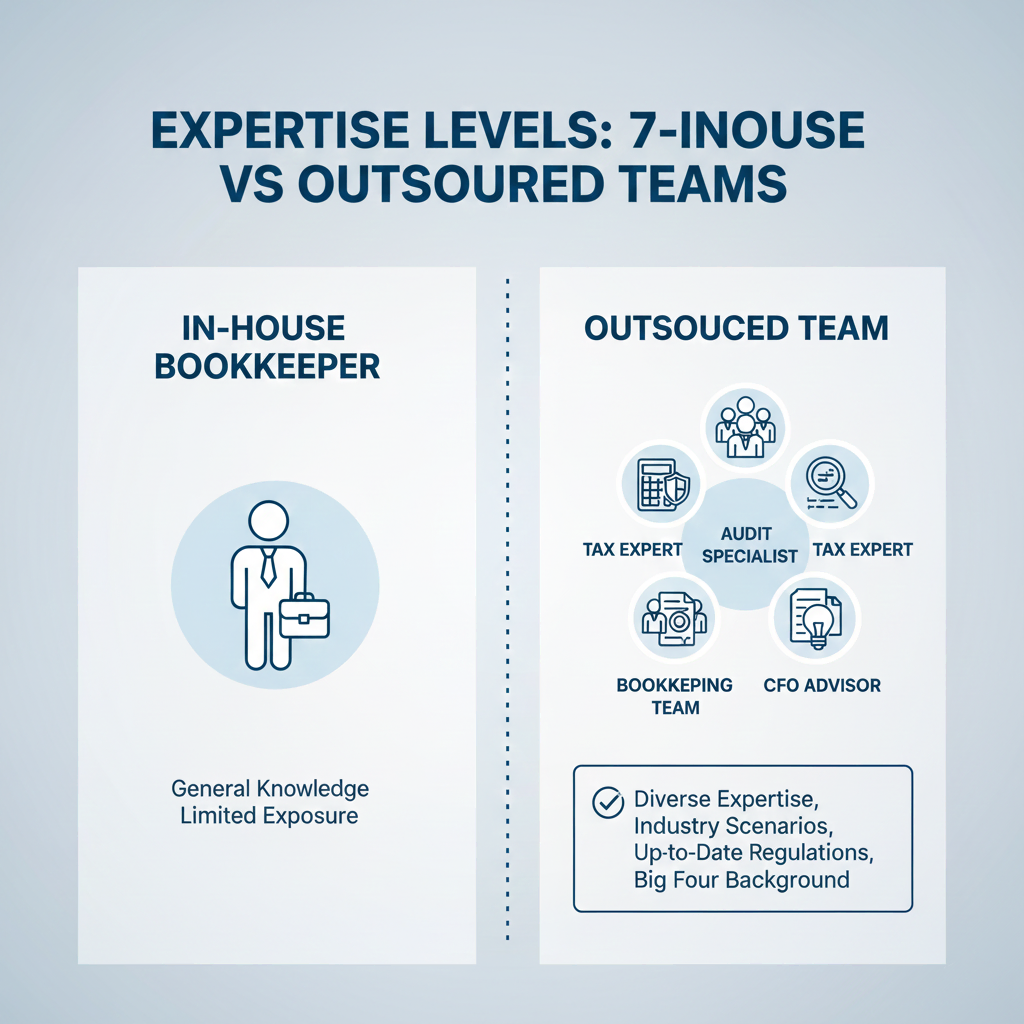
Most in-house bookkeepers aren’t chartered accountants. They lack Big Four experience. When complex situations arise, you need additional consultants.
Outsourced Bookkeeping Expertise
Professional accounting services in Dubai offer deeper capabilities. Teams include qualified chartered accountants. Many have Big Four backgrounds (ebs, PwC, Deloitte, EY, KPMG). At ebs Chartered Accountants, senior staff bring Big Four experience to SME clients. This means sophisticated expertise at accessible prices. The firm has served over 500 businesses since 2017. Additionally, outsourced teams see hundreds of scenarios. They handle multiple industries. They stay current with regulations automatically. Therefore, you get expert guidance without hiring multiple specialists.
Client feedback confirms this advantage.
Hamza Hassan shared:
“Great services regarding Audit, Accounting, Corporate Tax and VAT.”
Usama Rajpoot noted:
“ebs made everything so easy for us. Professional, friendly, and always responsive.”
Scaling Your Business: Growth Without Pain
Business growth creates predictable challenges. Your bookkeeping approach must scale smoothly.
In-house Scaling Problems
Growth exposes in-house limitations quickly. Transaction volume increases. Your bookkeeper struggles to keep pace. Backlogs develop. Financial reports arrive late. Moreover, complexity increases simultaneously. New revenue streams emerge. Multiple entities form. International transactions begin. Your bookkeeper may lack the specialized knowledge required. Employee absence creates immediate problems. Holidays leave work undone. Sick leave stops financial operations. Resignation creates a crisis. Hiring a second bookkeeper takes 2-3 months. Meanwhile, your business waits. This delay costs opportunities.
Outsourced Scalability Benefits
Professional firms scale effortlessly. During busy periods, they assign additional team members. You don’t manage hiring. You don’t handle training. Need transfer pricing advice? The firm’s specialists are available immediately. Require payroll outsourcing? It’s already integrated. When one team member is unavailable, others continue seamlessly. No knowledge loss occurs. Work doesn’t stop. ebs chartered accountants experienced this advantage directly. This business consulting firm hired ebs for ongoing accounting and tax filing. The CEO was extremely satisfied with the service. In fact, he recommended our services to other companies. The engagement involved 2-5 staff working together. This provided team flexibility without employee overhead. Your costs increase gradually with transaction volume. They don’t jump in fixed salary increments. This makes growth predictable and manageable.
Technology and Software: Modern Tools Matter
Modern bookkeeping requires sophisticated software. Each approach handles technology differently.
In-house Technology Limits
Your in-house bookkeeper typically knows one accounting platform. They use whatever they learned previously. Automation capabilities remain limited. Most data entry happens manually. Switching software becomes difficult. Your bookkeeper needs extensive training. This costs time and money. Many SMEs stay locked into specific platforms unnecessarily.
Outsourced Technology Advantages
Professional bookkeeping and accounting firms invest heavily in technology. They maintain multiple software certifications. They partner with leading platforms. ebs Chartered Accountants is an Advanced Zoho Partner. This demonstrates deep technical expertise in cloud accounting. Clients benefit from this partnership immediately.
| Technology Benefit | How It Helps Your Business |
| Multi-Platform Expertise | Works with Zoho, QuickBooks, Xero, Tally ERP |
| Automated Transactions | OCR captures receipts automatically |
| Real-Time Dashboards | View financial position anytime, anywhere |
| Payment Integration | Connects with Stripe and other processors |
| Complete Audit Trails | Digital records meet UAE compliance requirements |
| Cloud Security | Bank-level encryption protects your data |
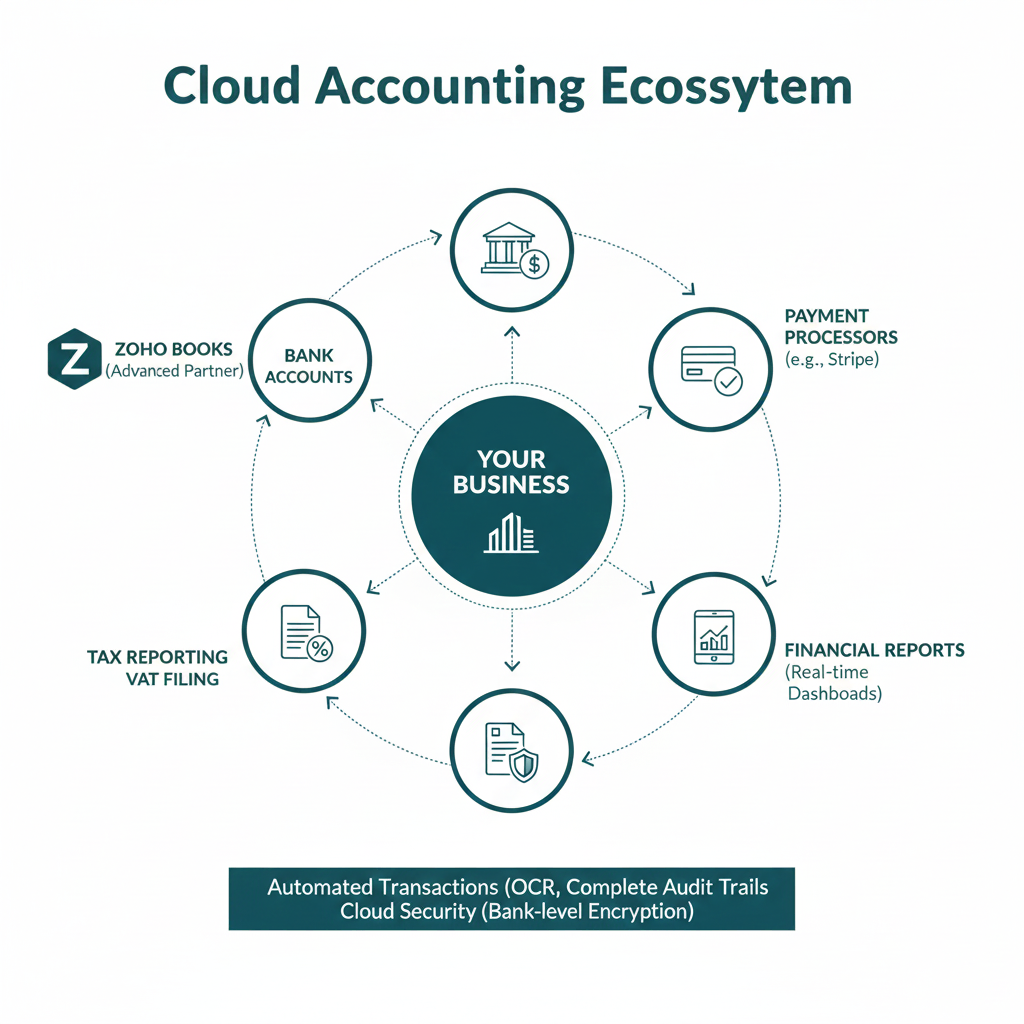
These capabilities create efficiency. They reduce errors. They ensure compliance. Furthermore, they provide the visibility you need for smart decisions.
Risk Management: Protecting Your Business
Financial risks extend beyond compliance penalties. Both approaches carry different risk profiles.
In-house Risks You Face
Your bookkeeper creates a single point of failure. They hold critical knowledge about your systems. If they resign suddenly, you face an immediate crisis. Fraud vulnerability increases with single-person control. Limited oversight creates opportunities for misconduct. Small businesses face particular vulnerability here. Moreover, knowledge gaps may not be visible. Your bookkeeper might miss compliance issues. Errors in complex calculations go unnoticed. Penalties arrive as unwelcome surprises.
Outsourced Risk Protection
Teams provide natural redundancy. Multiple professionals understand your account. One person’s absence doesn’t disrupt anything.
- Built-in controls protect you automatically. Different team members handle recording and reconciliation. This segregation of duties prevents fraud.
- Professional indemnity insurance adds another layer. Reputable firms carry coverage protecting clients. Errors get corrected without financial loss to you.
- Regular review by senior accountants catches problems early. Issues get resolved before they escalate. Your documentation stays audit-ready continuously.
When In-house Makes Sense
Despite outsourcing advantages, some situations favor in-house arrangements. Consider hiring internally if you meet these criteria:
- Your business processes 1,000+ transactions daily. You need instant access throughout the day. Immediate availability becomes critical.
- Alternatively, your industry has highly specialized requirements. Unique accounting standards apply. Dedicated expertise becomes necessary.
- Perhaps you’re approaching 100+ employees. You can build a complete finance department. Controllers, accountants, and bookkeepers work together. At this scale, in-house becomes economically viable.
- You might already have strong internal controls established. Internal audit functions exist. Segregation of duties is clear. Management capability is proven.
However, these scenarios represent the minority. Most Dubai startups and SMEs don’t meet these conditions.
When Outsourcing Is Your Best Choice
Most situations favor outsourced bookkeeping. Consider outsourcing if these describe your business:
- You’re a startup with a limited budget. Professional expertise matters but fixed costs are prohibitive. Outsourcing delivers quality without salary commitments.
- Your business is growing rapidly. You’re scaling from 5 to 50 employees. Internal teams can’t expand fast enough. Outsourced providers scale instantly.
- You lack financial expertise internally. Business owners aren’t accountants themselves. Professional guidance on strategy matters as much as transaction recording.
- UAE compliance concerns you. Corporate tax and VAT regulations seem complex. Expert handling reduces audit risk significantly.
- You need strategic CFO-level insights. Beyond bookkeeping, you want financial planning. You seek business advisory services. Professional firms provide integrated support.
- You want to focus on core business activities. Managing finance staff distracts from product development. It takes time from sales and customer service. Outsourcing removes this burden.
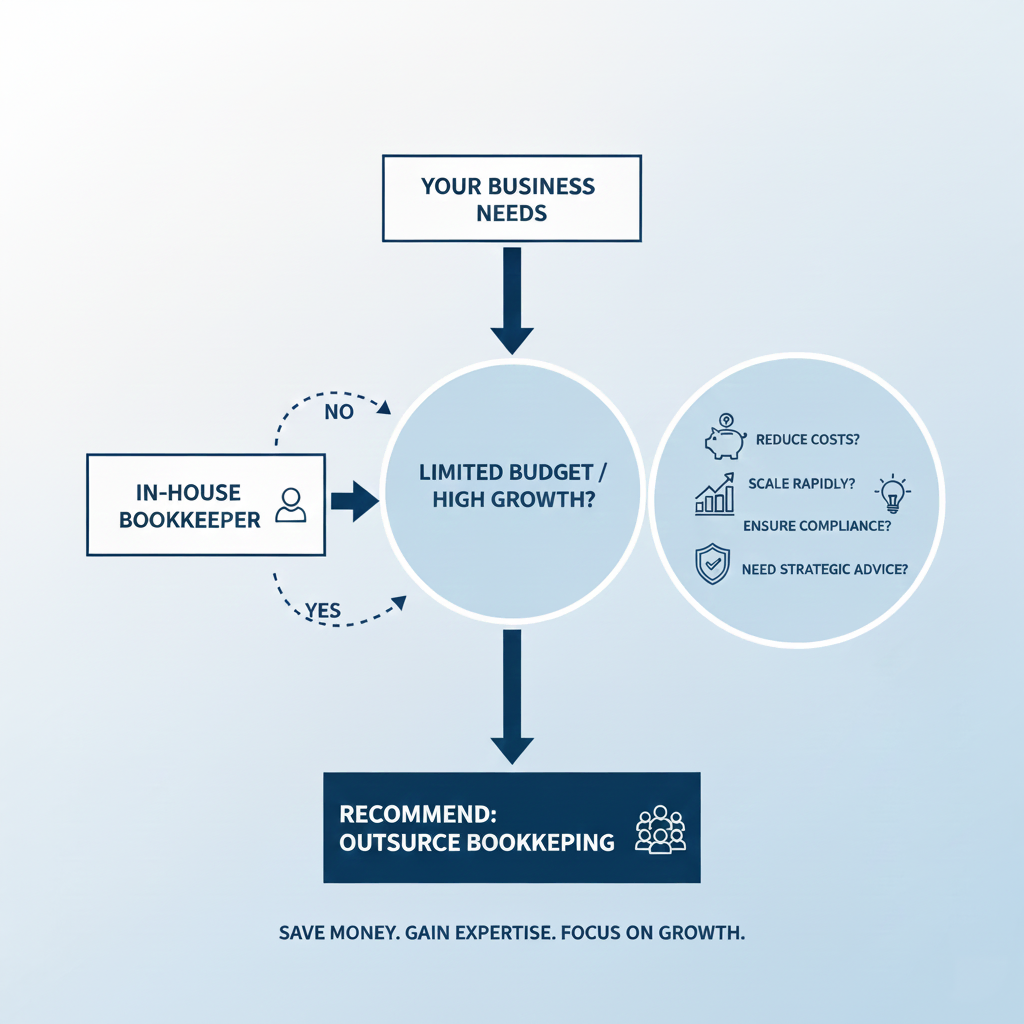
You require multiple integrated services. Bookkeeping, audit, VAT filing, payroll, and corporate tax all matter. One provider delivers everything seamlessly. Building equivalent in-house capability requires 3-5 specialists.
Choosing the Right Accounting Firm
Selecting your outsourced provider requires careful evaluation. Not all accounting services in Dubai offer equal quality.
Consider these essential criteria:
- Qualifications matter first. Look for qualified chartered accountants. Check for Big Four experience among senior staff. Credentials indicate expertise level.
- UAE-specific knowledge is critical. Your provider must understand local regulations thoroughly. Corporate tax, VAT, ESR, and free zone requirements all apply. Generic international experience isn’t enough.
- Technology partnerships demonstrate capability. Firms certified by Zoho, QuickBooks, or Xero show technical competence. These partnerships require ongoing training and standards.
- Regulatory approvals provide confidence. Check if the firm is approved by DIFC, DMCC, JAFZA, or RAKEZ. These approvals indicate regulatory recognition.
- Client reviews reveal real experiences. Third-party platforms like Clutch and Trustpilot provide verified feedback. Look for consistent positive ratings over time.
- Service integration simplifies operations. Can the firm handle bookkeeping, audit, tax, and payroll together? Or do they only offer basic services? Comprehensive providers save coordination effort.
- Communication quality affects daily experience. During initial consultations, assess responsiveness. Notice how clearly they explain concepts. Good communication prevents future frustrations. For detailed evaluation guidance, read our comprehensive article on how to choose the right accounting firm in Dubai.
ebs Approach to Professional Bookkeeping
ebs brings Big Four expertise to Dubai SMEs. Since 2017, the firm has guided 500+ businesses to success. Senior accountants all have Big Four backgrounds. This delivers sophisticated solutions typically reserved for large corporations. However, pricing remains accessible for startups and growing companies. Services extend beyond basic bookkeeping. ebs provides outsourced accounting and bookkeeping, audit, VAT compliance, corporate tax preparation, payroll outsourcing, and CFO services. Everything integrates under one roof.
Technology leadership sets ebs apart. As an Advanced Zoho Partner, the firm implements and optimizes cloud accounting systems. Clients gain real-time financial visibility and automated workflows. Regulatory approvals span all major UAE jurisdictions. ebs is an approved auditor across every major free zone. This demonstrates recognized credibility with authorities.
Client satisfaction remains consistently high. Clutch rates ebs at 4.9/5 based on 16 verified reviews. Trustpilot shows consistent 5-star feedback. Both platforms confirm reliable, professional service. The Dubai headquarters provides local expertise with global standards. This supports SMEs from the startup phase through rapid growth.
Making Your Decision: Questions to Answer
Determine which approach suits your business by answering these questions honestly:
- Budget reality check: Can you afford AED 10,000-20,000 monthly for in-house staff? Would AED 2,500-10,000 monthly preserve cash flow better?
- Expertise assessment: Do you need basic recording or sophisticated analysis? Are you confident handling corporate tax internally? Do complex situations require specialist input regularly?
- Growth trajectory: Are you scaling rapidly in the next 12-24 months? Will transactions double or triple soon? Do you need resource flexibility?
- Risk tolerance: Can your business survive sudden bookkeeper resignation? Are you comfortable with single-person financial control? How important is professional insurance?
- Strategic priorities: Is building a finance team your competitive advantage? Would you rather focus leadership time on customers? Do you need integrated advisory services?
Most Dubai SMEs discover that outsourced bookkeeping addresses their actual needs better. Additionally, it consumes fewer resources while providing superior results.
Your Next Step Forward
The choice between outsourced bookkeeping and in-house hiring impacts everything. It affects your financial health. It determines your compliance status. It influences your growth potential. For most startups and growing SMEs in Dubai, outsourcing delivers better outcomes. You get superior expertise at lower cost. You gain better scalability with reduced risk. The critical factor isn’t just choosing outsourced versus in-house. It’s selecting the right partner who understands UAE regulations. They must invest in technology. They must bring genuine expertise to your business.
ebs chartered accountants in Dubai combines Big Four experience with SME-focused service. This provides the financial foundation your business needs. You can grow confidently in Dubai’s dynamic market. Ready to discuss your specific bookkeeping needs?
Get a customized quote and transform your financial operations today.
Frequently Asked Questions
What is the main difference between outsourced bookkeeping and in-house bookkeeping?
Outsourced bookkeeping means hiring an external accounting firm to manage your records. In-house bookkeeping means employing your own dedicated bookkeeper. Outsourcing typically costs 50-75% less. Additionally, it provides access to a team of specialists rather than a single employee.
How much does outsourced bookkeeping cost in Dubai?
Outsourced bookkeeping services in Dubai range from AED 2,500 to AED 10,000 monthly. Startups with 1-10 employees usually pay AED 2,500-5,000. Growing SMEs with 10-50 employees pay AED 5,000-10,000. Costs depend on transaction volume and complexity.
Is outsourced bookkeeping secure for my business data?
Reputable accounting firms in Dubai use secure cloud systems with encryption. They implement strict access controls and digital audit trails. Professional firms also carry indemnity insurance. This often provides better security than in-house arrangements where one person controls everything.
What accounting software do outsourced firms use?
Professional firms work with multiple platforms including Zoho Books, QuickBooks, Xero, and Tally ERP. This flexibility allows them to use software that fits your needs best. You’re not limited to one system.
Can outsourced bookkeeping scale as my business grows?
Yes, scalability is a primary outsourcing advantage. Providers adjust team resources and service levels as you grow. Your transaction volume and complexity can increase without hiring additional staff. This makes outsourcing ideal for rapidly growing SMEs.