

Paper invoices are becoming history. The UAE is formally shifting in the direction of E-invoicing, marking one of the country’s largest virtual tax reforms yet. Between 2025 and 2027, the UAE E-invoicing reform will reshape how each commercial enterprise manages transactions, reporting, and compliance.
The UAE E-invoicing journey begins with a pilot phase on 1 July 2026, giving selected and voluntary taxpayers the chance to check the brand-new system before it becomes obligatory. For large enterprises with annual sales of AED 50 million or more, e-invoicing will be mandatory to implement ASP. These businesses must appoint an Accredited Service Provider (ASP) by 31 July 2026. Once appointed, they are required to start using the e-invoicing system from 1 January 2027.
The next phase, covering all other VAT-registered businesses, will begin on 1 July 2027.
For large taxpayers, this isn’t just a compliance deadline; it is a management opportunity. Early adopters benefit from quicker reporting, cleaner data, fewer errors, and a real competitive side in an increasingly digital economy.
What Is UAE E-invoicing?
UAE E-invoicing 2025 is the government’s next step in the direction of modernizing how enterprises file and proportion invoices. But it is more than going paperless. The aim is to tighten VAT reporting, lessen fraud, and provide each corporation and the Federal Tax Authority (FTA) a clearer, real-time view of each transaction.
The system operates on a 5-hook model. Instead of sending invoices without delay to customers, enterprises need to direct them via an Accredited Service Provider (ASP). The ASP validates each invoice checking format, data accuracy, and compliance with UAE VAT E-invoicing requirements before forwarding it to both the buyer and the FTA.
This guarantees a single, verified model of each transaction, blocking fake or duplicate invoices and enhancing tax transparency.
The preliminary rollout goals are Business-to-Business (B2B) and Business-to-Government (B2G) invoices, in which higher-value transactions occur. Business-to-Consumer (B2C) invoices will be observed later as soon as the system stabilizes.
If you are a large enterprise, now is the time to prepare. By familiarizing your structures and teams with the UAE E-invoicing framework, you can avoid last-minute compliance chaos.
UAE E-invoicing Timeline (2025–2027)
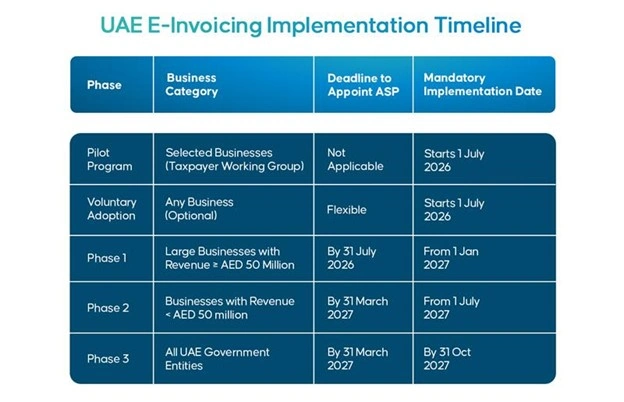
This UAE E-invoicing timeline makes one thing clear: waiting is not optional. Large taxpayers who are a part of the pilot phase gain valuable hands-on experience before the policies turn out to be law.
UAE E-invoicing Pilot Phase: Why It Matters for Large Taxpayers
The UAE E-invoicing pilot section (July–December 2026) allows selected large payers to check the system under real-world conditions without penalties.
Businesses that take part can:
- Train teams and refine workflows early.
- Identify integration gaps among ERP structures and ASPs.
- Resolve technical and compliance issues before deadlines.
Participation additionally enables the formation of the final version of the UAE E-invoicing framework, feeding real-time comments to regulators.
To join, large taxpayers need to:
- Contract an Accredited Service Provider (ASP).
- Map current invoicing workflows to the virtual model.
- Ensure ERP and accounting structures can generate and transmit invoices within the accepted PINT AE XML format.
Early checking makes implementation smoother, cheaper, and much less risky.
Why Early Adoption (Pilot) is Strategically Advantageous for Large Taxpayers
For large taxpayers (i.e., those with revenue ≥ AED 50 million), choosing to join the pilot phase can pay off in several meaningful ways:
- Risk Mitigation Before Mandates Kick In
By participating in the pilot, companies can test their systems, workflows, and internal controls well before the compliance deadline (1 January 2027). This gives them room to catch and fix issues — data mismatches, integration problems with ERP or ASPs, or training gaps — under lower-stake conditions. - Building In-House Expertise
Early adopters can train their finance and tax teams during the pilot, creating institutional knowledge. When the mandatory phase begins, they will already have the proper processes in place and be able to scale smoothly. - Better ASP Onboarding
Appointing an Accredited Service Provider (ASP) is a requirement. Early movers can negotiate and select their ASPs more deliberately and build a strong working relationship — which is essential for seamless e-invoice transmission, validation, and submission. - Data Quality and Process Optimization
During the pilot, companies can validate their master data, ensure required fields are being captured correctly, and align their systems to the UAE’s structured data specifications (data dictionary / PINT AE). Optimizing these processes early can enhance overall data quality and reduce reconciliation issues later. - Competitive & Reputational Edge
Leading the transition signals to partners, investors, and regulators that a business is future-ready, digitally mature, and compliant. This can improve trust and positioning in the marketplace. - Cost Efficiency Over Time
While there may be upfront costs — system upgrades, training, ASP fees — early adoption helps spread these costs out, avoiding the premium rush-mode costs that many companies face when they wait until the last minute. - Avoiding Non-Compliance Costs
Failing to comply once the mandate is live could carry substantial risks. While the Ministry has not publicly listed all penalty amounts, expert commentary warns of non-compliance exposure. Early adoption reduces the risk of fines, disruption, or denied VAT input claims.
Technical and Process Requirements
The UAE Ministry of Finance E-invoicing framework has strict requirements primarily based totally on PEPPOL.
Businesses need to:
- Capture all obligatory invoice data fields.
- Generate and transmit invoices in PINT AE XML format.
- Report transactions in real time or near real-time.
Integrating ERP structures with your preferred ASP is the most important step. Before going live, check your setup in professional FTA sandboxes to ensure easy records float and complete compliance.
Roadmap to Early Adoption for Large Taxpayers
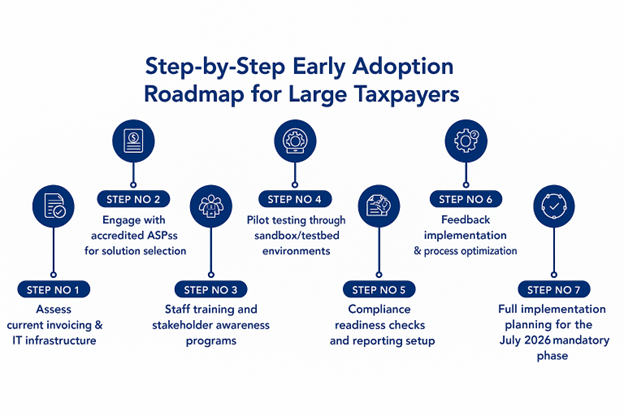
Here’s a practical seven-step roadmap to stay ahead:
Step: 1: Assess current invoicing structures pick out compliance gaps and technical limitations.
Step: 2: Engage ASPs shortlist carriers approved beneath UAE requirements.
Step: 3: Train staff to make sure finance, procurement, and IT groups understand the process.
Step: 4: Run pilot tests using sandbox environments to trial real-time invoicing.
Step: 5: Verify compliance to test all required record fields and formats.
Step: 6: Optimize processes automate anywhere feasible to lessen manual guide effort.
Step: 7: Prepare for go-live to finalize contracts, budgets, and support team before January 2027.
How ebs Helps Businesses Transition Smoothly?
ebs chartered accountants in Dubai is one of the UAE’s main tax and commercial enterprise consultancy firms, guiding corporations via UAE E-invoicing implementation.
Their team helps enterprises:
- Evaluate machine readiness and select the proper ASP.
- Integrate ERP structures with E-invoicing platforms.
- Conduct compliance checking out and training.
- Provide ongoing guidance earlier than and after the mandate.
With expert partners like ebs, you can navigate the transition confidently accomplishing compliance, efficiency, and a smooth competitive aspect withinside the UAE’s digital economy.
FAQs
What is UAE E-invoicing?
UAE E-invoicing is a digital invoicing system that routes verified invoices through accredited service providers for compliance and real-time VAT reporting.
When does UAE E-invoicing become mandatory?
E-invoicing is mandatory from 1 January 2027 for large taxpayers and 1 July 2027 for all other VAT-registered businesses.
Who needs to join the UAE E-invoicing pilot phase?
Large taxpayers with annual revenues above AED 50 million can voluntarily join the pilot phase starting 1 July 2026 to test and prepare early.
What are the benefits of early UAE E-invoicing adoption?
Early adoption ensures compliance, prevents penalties, improves data accuracy, and streamlines VAT reporting before the 2027 deadline.