

The UAE is continuously adopting the world’s best practices in order to establish tax transparency and digital transformation. As a big step, the UAE Ministry of Finance has introduced Ministerial Decision No.243 of 2025 and Ministerial Decision No.244 of 2025 with detailed guidelines on launching its national Electronic Invoicing System.

However, the market is filled with misconceptions, myths, and incorrect assumptions about the working model of e-invoicing. The main reasons are;
- UAE is following a unique model of e-invoicing
- The law published is very new in the country, and it will change many traditional practices in the current market
- E-invoicing includes technical issues.
This blog will break down the 13 most common misconceptions related to e-invoicing and provide clarifications to ensure your business is ready before the mandatory deadlines kick in 2027.
Common Misconceptions About E-Invoicing in the UAE
Misconception 1: The ASP will fix everything for us.
Reality:
An Accredited Service Provider (ASP) must be appointed by every company based on the deadline specified by the minister. The ASP provides a technical platform for e-invoicing; the business remains responsible for:
- Provide accurate invoice data
- Valid details, including TRN
- Date of invoice and date of supply determination
- Correct VAT treatments for the supply
The ASP provides only a tool, not the tax compliance
Misconception 2: VAT returns will be auto-populated
Reality:
Not at the moment.
The FTA has not yet announced the auto-population of VAT returns. Businesses must continue doing:
- VAT returns
- VAT reconciliations
- Documentation relating to export documentation
- Reverse Charge entries.
An e-invoice is a compliance measure; it does not replace the mandatory requirement of VAT filing.
Misconception 3: Only VAT-registered companies are required to comply.
Reality:
Absolutely No.
The Ministerial Decision has explicitly mentioned that e-invoicing applies to all businesses, not only for VAT-registered businesses, except the businesses which are outside the scope of e-invoicing compliance.
Misconception 4: Free Zone companies are out of scope.
Reality:
All Free Zone entities must comply with e-invoicing requirements unless they exclusively deal with B2C transactions. B2C transactions are temporarily not in the scope of e-invoicing requirements.
Free Zones (DMCC, JAFZA, DAFZA, Meydan, RAKEZ, etc.) must comply.
Misconception 5: Administrative VAT exceptions on invoice issuance will continue.
Reality:
E-Invoicing regulations override administrative exceptions issued by FTA to taxable persons.
Invoices which are not in the specified standards, delayed invoice issues and manual approvals will not be allowed with the go-live of e-invoicing frameworks.
Every invoice must be:
- In a structured format
- Sent in real-time through the Accredited Service Provider.
Misconception 6: If we have no revenue, we don’t need e-invoicing.
Reality:
Incorrect.
Even if no revenue or no invoices are issued, a business must still:
- Appoint ASP
- Configure the PEPPOL ID
- Maintain readiness
- Issue e-invoices when the transactions eventually occur
Revenue levels are not a requirement for e-invoicing compliance
Misconception 7: PDF invoices will no longer be accepted.
Reality:
Although PDF invoices are not considered official tax invoices, businesses can continue sending PDF/ Image copies of invoices to their customers. Official Tax Invoices are generated in a structured format in an XML/UBL file, which is validated by ASP
Misconception 8: The UAE is using the same system as KSA, India, or Malaysia.
Reality:
The UAE is following its own unique model of e-invoicing framework, which is a decentralized model. FTA will act as a regulator and audit authority, whereas ASPs are working on validation and approval of invoices. UAE’s e-invoicing model is not identical to:
- Saudi’s ZATCA e-invoicing
- India’s GST IRP
- Malaysia’s Myinvois
Please do not make the mistake of assuming that e-invoices around the globe are the same; they are not.
Misconception 9: The revenue threshold is based on VAT return turnover.
Reality:
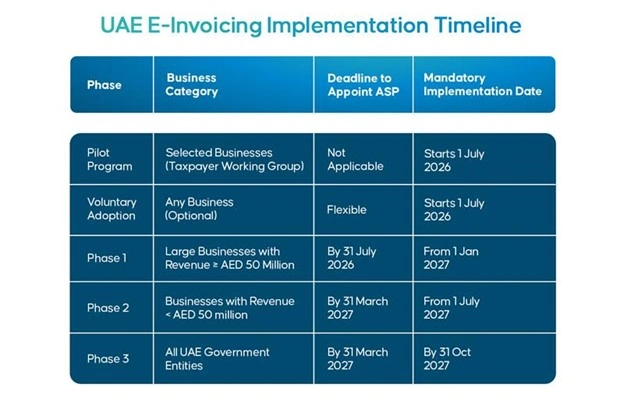
The MoF, UAE, has announced the deadline to appoint ASP and go live with e-invoicing in Phase 1 and Phase 2. The deadline is determined based on the revenue of the business in the financial statements, not from the VAT return figures. Ministerial Decision No.244 of 2025 has clearly defined the term “Revenue”
Do not miss the deadline for the appointment of ASP and go live with the misconception of the revenue threshold.
Misconception 10: In a tax group, only the representative member must comply.
Reality:
While transactions within the tax groups are outside the scope of VAT, it does not exclude the e-invoicing compliance to generate the invoices for intra-group transactions. Each license in the tax group must appoint an ASP, generate invoices for their business transactions, including the transactions within the tax group.
The tax group has no special exemption in e-invoicing.
Misconception 11: The ASP will only charge us for sales invoices.
Reality:
ASPs are charging based on the number of documents processed through their platform. While many business owners think only they will pay for the sales invoices generated, the fact is that even purchase invoices are also required to be validated. Credit notes and debit notes are also coming under the validation.
Do not assume the ASP will charge only for the sales invoice
Misconception 12: All e-invoicing data must be stored in UAE servers.
Reality:
ASPs must meet the standards set by FTA’s accreditation security standards, which include secure international hosting. However, it is not mandatory that the data must be stored in the UAE-based servers.
Currently, UAE-based hosting is not mandatory. Authority may make data sovereignty rules in future.
Misconception 13: Once we implement e-invoicing, we are automatically VAT compliant.
Reality:
E-invoicing compliance is to report the invoices in a structured format to the authority on a real-time basis; it does not give a tax compliance guarantee. Businesses must still ensure:
- Timely return filings
- Correct VAT rate
- Correct place of supply
- Keep valid supporting documents
E-invoicing does not fix accounting errors.
Final Thoughts
E-Invoicing is a major step in the UAE towards tax transparency and digital compliance to increase the efficiency of the authority and businesses in the country. The misconception can be costly not only in terms of penalty but also in the disallowance of expenses for non-compliance.
Businesses should start preparing now by:
- Assessing existing systems
- Training the finance, IT and Tax teams.
- Engaging an FTA-approved tax agent
- Selecting an Accredited Service Provider
- Mapping the entire VAT process.
ebs chartered accountants is fully ready to support you in complying with the new e-invoicing rules.
FAQs
Does e-invoicing apply only to large companies in the UAE?
No. The deadlines for appointing ASP and going live are different based on the revenue threshold. In the end, e-invoicing compliance is mandatory for all businesses.
Are Free Zone companies excluded from e-invoicing?
Unless Free Zone companies are conducting only B2C transactions, they also must comply with e-invoicing requirements.
Can ASPs fix VAT coding mistakes?
No, VAT treatments remain the sole responsibility of the taxpayer.
Will the FTA auto-populate my VAT return once e-invoicing begins?
No. VAT return is required to be filed as per the current set process; no auto-population of VAT return at the moment.
Is e-invoicing mandatory for companies with no revenue?
Despite revenue and number of invoices, all entities must appoint ASP and comply.
Do PDF invoices become invalid under e-invoicing?
Businesses can still send the soft copy or hard copy of invoices to get the payments. However, the official invoice is always the structured file generated through the ASP.