
Accredited by whom? The finance manager said it out loud in an empty office. The email on her screen said every invoice would soon have to move through an accredited service provider. It said nothing else that helped. She is made up for this guide but the question is one many finance teams are asking right now.
This guide explains e-invoicing accredited service providers in plain words. You will see how to check one and how to choose an e-invoicing service provider and which questions to ask an e-invoicing provider before you sign anything.
What Is an Accredited Service Provider for E-Invoicing?
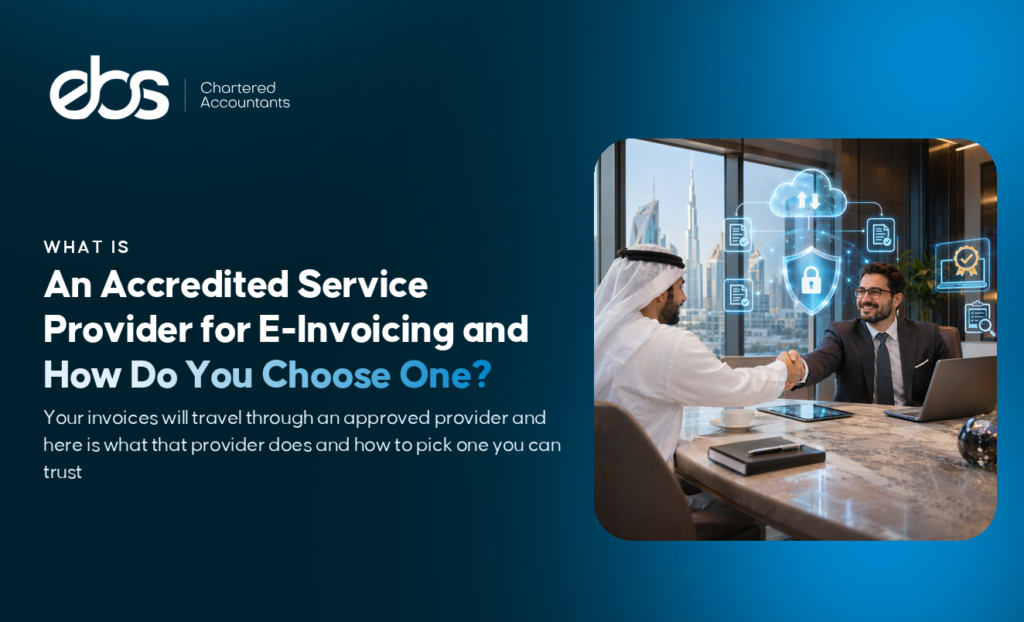
An accredited service provider or ASP is a technology company approved by the UAE Ministry of Finance to handle e-invoices for businesses. That is how ebs describes it on its e-invoicing page. The provider sits between the buyer and the seller. It moves the invoice and checks that it meets the technical and legal rules.
The UAE system is built on the PEPPOL five corner model with the Federal Tax Authority in the fifth corner. Invoices are created in a structured XML format and not as simple PDFs. So e invoicing accredited service providers are not just another invoicing app. They are the approved link in the chain and ebs says every business must work through one.
Who Needs E Invoicing Accredited Service Providers and When?
Not every business needs e invoicing accredited service providers on the same date. The ebs page sets out a phased rollout. A pilot for selected businesses began in July 2026 and covers B2B and B2G transactions. Mandatory adoption starts on 1 January 2027 for businesses with annual revenue of AED 50 million or more. Later phases cover smaller businesses and government entities. B2C is currently out of scope.
Dates can move so confirm yours with the Ministry of Finance. If your revenue is below the first threshold you still have time. Use that time to learn how to choose an e-invoicing service provider calmly.
Where Can You Find the List of E Invoicing Accredited Service Providers?
The Ministry of Finance publishes the list on its own website. At the time of writing it showed 88 providers in alphabetical order. Each entry gives the company name and an accreditation number and a website and contact details. The Ministry says it updates the list as new providers are accredited.
Treat that list as your single source. How to choose an e-invoicing service provider starts with who is allowed to offer the service at all. A badge or a claim on a provider’s own site is not proof. The Ministry page doesn’t spell out a checking routine so here is a simple one of our own.
- Search the company name on the official list.
- Match the accreditation number to the one the provider gave you.
- Check that the website and contact details match too.
- Ask the provider to confirm its status in writing.
- Save a dated copy of the entry for your file.
One provider guide says some providers are only pre-approved and that this status is for pilot testing. Ask which status a provider holds and treat that guide as one opinion and not an official rule.
How to Choose an E-Invoicing Service Provider Step by Step
Accreditation is the minimum and not the finish line. KPMG explains that accreditation tests whether a provider can meet PEPPOL standards and keep control over invoice exchange and reporting. It also asks for ISO certificates and at least two years of e-invoicing experience. That tells you what accredited means. It doesn’t tell you which provider fits your business. Among e invoicing accredited service providers the real gaps show up in fit and support.
So how to choose an e-invoicing service provider comes down to a few checks. Score each shortlisted provider against the others. One guide warns that picking the first name on the approved list is not enough.
| Check | Why it matters |
| Accreditation | The provider appears on the official list with a matching number |
| Fit with your system | Invoices should flow from your ERP or accounting software without retyping |
| Rejected invoice handling | You need to see errors and fix them and resend fast |
| Data location and backups | You should know where invoice data sits and who can reach it |
| Support and updates | Rules will change and the provider must keep pace |
| Exit terms | You should be able to take your data and leave |
If you run several legal entities or branches then ask whether each one can be set up on its own. Guides say each entity in a group needs its own setup.
Clean records make every step easier. KPMG notes that reviewing your transactions and your master data early eases onboarding. If your books need work first then look at the ebs accounting and bookkeeping services.
Which Questions to Ask an E-Invoicing Provider Before You Sign
Good questions to ask an e-invoicing provider are short and need a clear answer. Use these questions to ask an e-invoicing provider on every demo call.
- What is your accreditation number and can I see it on the official list
- Can you show live what happens when an invoice is rejected and how it gets resent
- Where is our invoice data hosted and backed up and who can access it
- What happens to our data and what does it cost if we leave
- Can you set up each of our entities or branches separately
- What uptime and incident response do you commit to and what happens if reporting is delayed
- How fast do you update the system when the rules change
Write down the answers. Vague replies are a reason to move on. The same list works for any firm that sells e invoicing accredited service providers as a service.
What Should an E-Invoicing Provider Contract Cover?
Knowing how to choose an e-invoicing service provider doesn’t end at the demo. Put the answers to those questions to ask an e-invoicing provider into the contract. Guides suggest the contract should cover the scope of service and uptime and incident response and who pays when reporting is late. It should also cover where data is stored and backed up and how fast the provider updates for rule changes. Ask about subcontractors and about how you get your data back at exit.
Some of these numbers come from vendors who sell the service so treat their exact figures as opinion. If you are a bank or another regulated firm then check your own regulator’s rules too. One article by the head of an accredited provider argues that accreditation does not replace your own due diligence. He has a commercial interest but the point is fair.
Incoming bills matter as well. Supplier invoices will arrive in the new format so look at how your payables team will handle them. The ebs page on accounts payable outsourcing covers supplier invoice processing.
Does Your Buyer Need the Same Provider as You?
No. One guide notes that invoices route through the buyer’s provider. So your customer’s provider may not be yours. That is normal.
Whether one business may run two providers is a different question. The official list page and the guides we read don’t say. Ask the Ministry of Finance or your advisor before you split the work. Our own view is that a second provider adds cost and one more thing to monitor. Add it to your questions to ask an e-invoicing provider.
Quick Tip
Before you decide give each shortlisted provider the same ten invoices. Pick the messy ones with credit notes and discounts and mixed VAT rates. Compare how each system handles them and pair the test with your questions to ask an e-invoicing provider. This is the fastest way to learn how to choose an e-invoicing service provider with real evidence and not sales slides.
Frequently Asked Questions
Accredited service providers for e-invoicing are technology companies approved by the UAE Ministry of Finance to process electronic invoices. They securely transfer invoice data between suppliers and buyers while checking that invoices meet UAE e-invoicing requirements.
Yes. UAE e-invoicing is being introduced in phases. Mandatory implementation begins on 1 January 2027 for businesses with annual revenue of AED 50 million or more. Smaller businesses and government entities follow in later phases. Businesses should confirm their applicable deadlines with the UAE Ministry of Finance.
Your accounting or invoicing system sends invoice data in a structured electronic format to your accredited service provider. The provider validates and exchanges the invoice with the buyer’s service provider, while the required tax data is reported to the Federal Tax Authority. This process follows the Peppol five-corner model.
No. A standard PDF or image of an invoice does not qualify as a UAE e-invoice. A compliant e-invoice must contain structured electronic data, such as XML, that can be processed and exchanged between systems. Check the required format with your accredited service provider.