

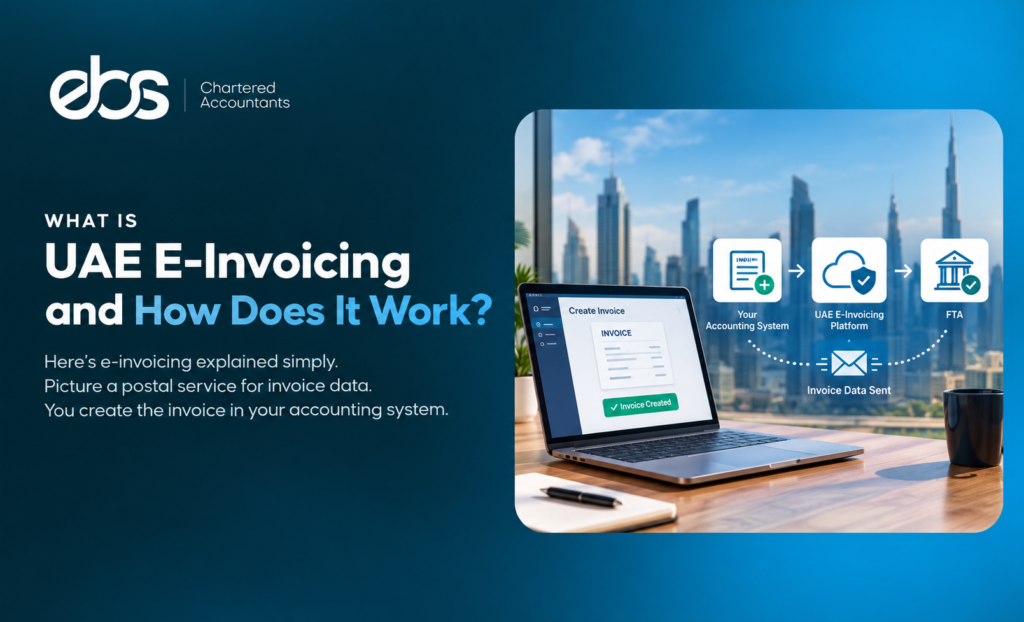
Most owners hear e-invoicing and picture a nicer PDF. It isn’t that. e-invoicing turns every invoice into data that moves through an approved system and the Ministry of Finance is rolling that system out in phases.
At ebs chartered accountants we’re hearing one question more than any other. Will this break my invoicing? Not if you prepare before your phase starts.
How Does E-Invoicing Work in UAE?
Here’s e-invoicing explained simply. Picture a postal service for invoice data. You create the invoice in your accounting system. Your provider checks it and sends it on. On the other side the customer’s provider delivers it and their system reads it.
Four parties are involved. You as the seller. Your customer as the buyer. A service provider on each side. And the authority that receives the data. Knowing who does what in the invoicing process makes the rest easy to follow.
What Makes an E-Invoice Different From the PDF?
The table shows the e-invoice vs PDF invoice comparison row by row.
| PDF Invoice by Email | E-Invoice | |
| What it is | A picture of an invoice | Invoice data a system can read |
| Who checks it | A person | Software during sending |
| How it travels | Straight to the buyer’s inbox | Through approved providers on a network |
| What the buyer does | Types or scans the details into their system | Loads the data straight into their system |
| Errors | Found later by people | Flagged by the system as it is sent |
That’s why a PDF is not an e-invoice even if it looks perfect. A person can read it. Software can’t rely on it because it needs each detail in a fixed place.
Think about supplier invoices today. Someone opens an email. Then a colleague types the numbers into the accounting system. That typing is where mistakes creep in. It’s the structured data invoice vs image invoice problem and software can check data in a way it never can with a picture.
Is a Digital Invoice the Same as an E-Invoice?
Not quite. People use the two terms as if they mean the same thing. A digital invoice is any invoice in electronic form. An e-invoice is built from structured data that systems can read and check. Plenty of businesses already send scanned copies against true e-invoices without noticing the gap. A scan looks like paper on a screen. It carries no data a system can use. So when someone asks about the e-invoice vs PDF invoice in UAE the honest answer is simple. One is a picture and the other is information.
Follow a single invoice. These are the steps an e-invoice goes through.
- You raise the invoice in your accounting system.
- Your provider checks the data and the format.
- The invoice travels through the approved network.
- Your customer’s provider receives it and passes it to their system.
- The authority receives the invoice data as required.
- Both sides keep their own record.
Most of this happens behind the scenes. The work is in getting your data right before the first invoice goes out. UAE e-invoicing rewards the business that checks its customer list before the system does.
What Changes for Your Accounting Team?
Electronic invoicing in the UAE changes three things day to day. Invoices come from a system rather than from a template in a document. Customer details must be complete and exact. And someone owns the connection to the provider. Our team tells clients to start with the customer list. Missing names and addresses and tax numbers cause trouble in any national e-invoicing platform rollout. Think of the e-invoice life cycle from issue to receipt as a chain. One weak link slows every invoice behind it.
Quick tip. Export ten recent invoices and check every customer detail on them. Blanks and typos found now are cheap to fix. A structured invoicing system UAE businesses depend on will reject what a person would let slide.
Which Myths Should You Ignore?
Ask how does e-invoicing works in UAE and you’ll meet three myths fast.
- Myth: only big companies are affected. The rollout happens in phases so smaller firms follow later but still need to prepare.
- Myth: a PDF with a QR code is enough. In the e-invoice vs PDF invoice in UAE comparison the data wins. The invoice has to be structured data rather than a better looking picture.
- Myth: my accountant will handle everything. Your accountant can lead the project but only you know your customers and contracts.
What Should You Do Before Your Phase Starts?
E-invoicing in the UAE rewards small moves made in good time.
- Find out which phase your business falls into.
- Clean up your customer and supplier records.
- Ask your accounting software vendor about e-invoicing support.
- Talk to your key customers about their plans.
- Pick one person to own the project.
Then watch the official sources. Dates and rules for the UAE e-invoice network can change so check them before you commit to anything.
How Can an Accountant Help You Prepare?
Wondering how e-invoicing works in UAE for your business? An accountant can map it out. They review your invoice data and your customer records and your software and then compare providers with you.
At ebs chartered accountants we start with a simple test. Can a system read your invoices or only a person? If it’s only a person you have an e-invoice vs PDF invoice gap to close and that’s the first job on the plan.
Frequently Asked Questions
E-billing means sending a bill electronically, such as a PDF by email. E-invoicing involves issuing invoices as structured data that accounting systems can read, validate, and exchange automatically. This is the key difference between an e-invoice and a PDF invoice in the UAE.
An e-invoice is different from an emailed PDF invoice because its information is shared as structured data through approved channels. You may still provide customers with a readable copy, but businesses must follow the official UAE e-invoicing requirements applicable to their implementation phase.
Yes. Both buyers and sellers need to be prepared for the e-invoicing process. Your customers’ accounting systems or service providers must be able to receive structured invoices through the required channels. Discuss their readiness and implementation plans with your key customers.
An accredited service provider helps businesses send and receive UAE e-invoices through the approved network. It validates invoice data, checks the required format, and transmits the information to the relevant parties according to UAE e-invoicing requirements.