

Accrual vs Cash Accounting: Which Method is Accepted Under UAE Corporate Tax
The selection of accounting procedures is a very important choice that businesses in the UAE should make. It not only impacts daily bookkeeping but also adherence to the UAE corporate taxation regulations.
There are two most used accounting methods, accrual and cash accounting, both having their own pros and cons, and the one that fits your company best based on the size and complexity of the operations.
These methods can be understood in order to ensure that the businesses keep proper records, plan to grow, and pay taxes effectively.
What is Cash Accounting?
Cash accounting is a transaction mode in which transactions are only recorded upon the receipt or payment of cash. When money is received, revenue is recorded, and when it is paid out, then that is when expenses are recorded.
It is a straightforward approach, not complex, and best suited to small companies and freelancers whose cash flows are not complex. Nevertheless, cash accounting does not give the full picture of the financial status of your business, especially when you are owed money or there are large amounts of liabilities in the future.
What is Accrual Accounting?
Accrual accounting records when earnings or the incurring of transactions occur, although money may not change hands yet. Revenues are considered to be realized when a service has been provided, or a product has been sold, and expenses are recorded when a commitment has been made.
This approach gives a better picture of the financial performance, and it is usually favored by bigger businesses, companies that are interested in investors, or companies that have complicated financial activities. Under accrual accounting, the planning, forecasting, and reporting are more capable and in accordance with the international standards.
Main Difference Between Accrual and Cash Accounting
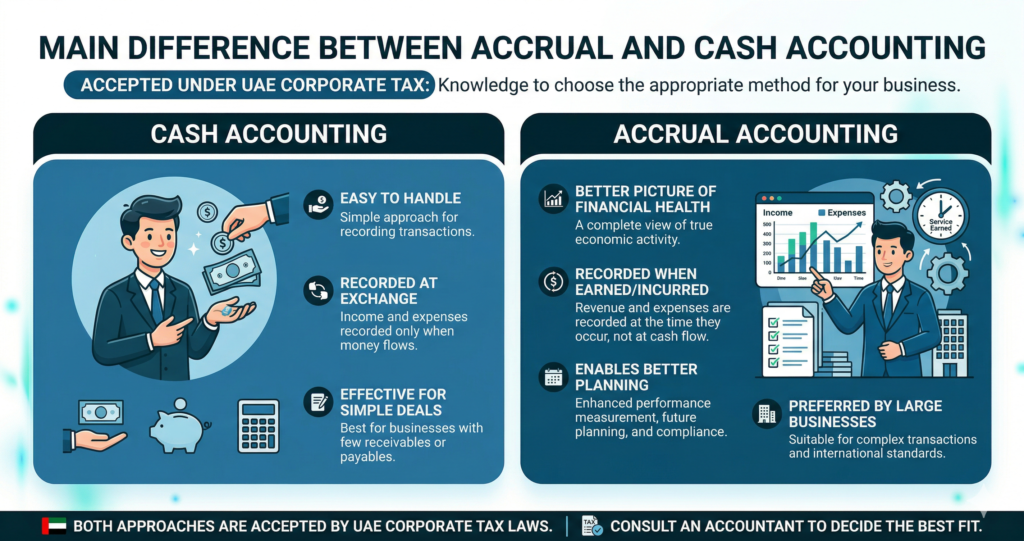
Although both cash accounting and accrual accounting are acceptable under UAE corporate tax, the knowledge of the differences aids in helping businesses to select the most appropriate method. Cash accounting is easy to handle since only the income and expenses are recorded upon the exchange of money. This approach is effective in companies whose deals are simple and have few receivables or payables.
The accrual accounting gives a better picture of the financial health of a company on the other side. It records revenue and expenses at the time they are earned or incurred and not at the time money flows. This enables the businesses to have better performance measurement, future planning, and ensure compliance with more complex reporting requirements.
The two approaches are accepted by the UAE corporate tax laws. Large businesses or those with complex transactions normally prefer accrual accounting because it is more suitable in the accounting standards of an internationally recognized company, and provides a better understanding of financial performance.
What Approach is Authorised by the UAE Corporate Tax?
The larger businesses or companies with complicated transactions tend to prefer accrual accounting since it corresponds to international accounting standards and gives a more distinct view of the financial health.
The accounting of cash may be well applicable to small enterprises whose cash flows are simple, and proper accounting records must be maintained to maintain compliance with the Federal Tax Authority (FTA).
Pros and Cons of Each Method
Cash Accounting
Pros:
- Simple to set up and support.
- Performs a reflection of cash flow.
- Very few accounting skills are needed.
Cons:
- May distort the financial performance of enterprises that have huge receivables or payables due.
- Minimal perspective in long-term planning, or attractiveness to investors.
Accrual AccountingPros:
- Gives a full and factual financial image.
- Applicable in the planning, forecasting, and strategic decision-making.
- Favored by investors and lenders
Cons:
- Higher order and time-consuming.
- Needs sound accounting and qualified management.
The Question of Simplicity Versus Accuracy: Accrual vs Cash Accounting of Small Businesses
For small businesses in the UAE, choosing between cash and accrual accounting often comes down to a simple trade-off: ease versus deeper insight.
Cash accounting works well when things are straightforward. If you’re running a startup or a small operation with limited transactions, it keeps everything easy to track. You record money when it comes in and when it goes out, so you always know your actual cash position without needing complex tracking.
On the other hand, accrual accounting gives a clearer picture of how your business is really performing. It records income and expenses when they happen, not just when cash moves. This makes it a better fit for businesses planning to grow, handle corporate taxes, or attract investors. It helps you understand profits more accurately and make better long-term decisions.
In the end, the right choice depends on your business structure, how complex your transactions are, and where you want to go in the future. If you’re unsure which approach suits your situation, working with professionals like ebs Chartered Accountants can make the decision much easier, while ensuring your accounting stays aligned with UAE regulations and your growth plans.
Frequently Asked Questions
Would accrual accounting be effective in small businesses in the UAE?
Yes. Accrual accounting can be employed by small businesses when they desire an in-depth perspective of the finances, even though cash accounting is easy to use by businesses with a clear cash flow.
Which is a superior accounting method that is tax-wise in the UAE?
Indeed, Cash and accrual accounting are both accepted in the UAE corporate tax. This is determined by the size of the business operations, the complexity of the transactions, and reporting needs.
What are the dangers of accounting for cash in a growing business?
Well, cash accounting can make your performance look bad when you have a big amount of receivables or payables.