

Running a business in Dubai without proper accounting software in 2026 is a serious risk. With Corporate Tax at 9% now fully in effect, FTA e-invoicing phases 2 and 3 rolling out, and 60% of UAE SMEs still spending 15-20 hours monthly on manual bookkeeping, the cost of staying on Excel or outdated systems has never been higher. Miss a VAT filing deadline or fail an FTA audit, and penalties start at AED 10,000 not counting the time lost fixing errors.
Choosing the right tool feels overwhelming. Zoho Books, QuickBooks, Xero, TallyPrime, Wafeq, Odoo which actually handles UAE-specific requirements like Arabic invoices, WPS payroll, multi-currency, and automatic Corporate Tax calculations? This guide cuts through the noise with real AED pricing, honest comparisons, and a proven implementation roadmap from experts who have completed 250+ UAE deployments.
Why UAE Businesses Need Professional Accounting Software Solutions in 2026
The UAE’s regulatory landscape shifted dramatically, and manual processes simply can’t keep pace.
Corporate Tax Compliance Is Non-Negotiable
Since June 2023, mainland and most free zone businesses must file Corporate Tax returns with accurate profit calculations and FTA-aligned tax schedules. Manual spreadsheets simply cannot handle this reliably.
FTA E-Invoicing Is Mandatory
Phase 2 requires XML/PEPPOL-formatted invoices with real-time reporting. If your software cannot generate compliant e-invoices, you are already behind.
VAT Errors Are Expensive
Returns are due quarterly (monthly for large businesses), and administrative penalties start at AED 1,000 per error. Automated VAT categorization and reconciliation cuts filing time from hours to minutes.
Multi-Currency & Bank Feeds Matter
Dubai’s trading businesses handle USD, EUR, and AED daily. Modern software syncs directly with Emirates NBD, Mashreq, ADCB, and other UAE banks, pulling transactions automatically and eliminating manual conversion errors.
The payoff is significant. Businesses that make the switch typically save 40-65% on monthly accounting expenses. One Dubai trading client reduced bookkeeping time by 70% after moving from Excel to Zoho Books, saving approximately AED 45,000 annually while improving accuracy.
Important reminder: software is only 30% of the solution. The remaining 70% is compliance knowledge and proper setup. That is where professional implementation makes the difference.
Must-Have Features for Any Accounting Software Solution in the UAE
Before comparing specific tools, understand what’s non-negotiable for UAE operations. Use this checklist to evaluate any software:
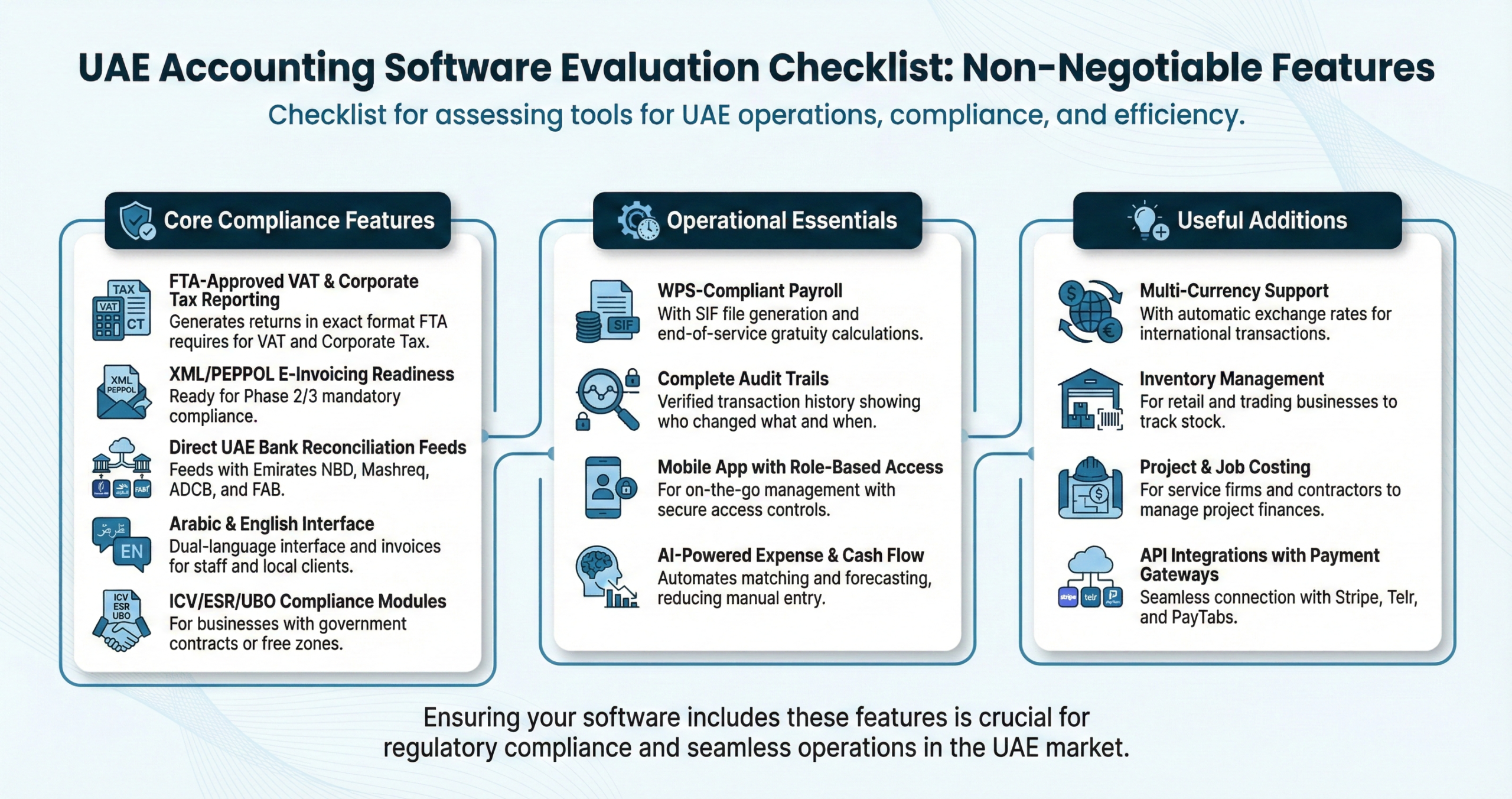
Core Compliance Features
- FTA-approved VAT and Corporate Tax reporting that generates returns in the exact format FTA requires
- XML/PEPPOL e-invoicing readiness for Phase 2/3 mandatory compliance
- Direct UAE bank reconciliation feeds with Emirates NBD, Mashreq, ADCB, and FAB
- Arabic and English interface with dual-language invoices practical for staff and local clients
- ICV/ESR/UBO compliance modules for businesses working with government contracts or free zones
Operational Essentials
- WPS-compliant payroll with SIF file generation and end-of-service gratuity calculations
- Complete audit trails with verified transaction history who changed what and when
- Mobile app with role-based access controls for on-the-go management
- AI-powered expense matching and cash flow forecasting to reduce manual data entry
Useful Additions
- Multi-currency with automatic exchange rates
- Inventory management (for retail and trading businesses)
- Project and job costing (for service firms and contractors)
- API integrations with payment gateways like Stripe, Telr, and PayTabs
Detailed Comperison Comparison
| Software | Best For | Monthly (AED) | Impl. Cost (AED) | VAT/CT Filing | Arabic |
|---|---|---|---|---|---|
| Zoho Books | Dubai SMEs (5-50 staff) | 150–300 | 2,000–5,000 | Full | Yes |
| QuickBooks Online | Established businesses | 250–450 | 3,000–6,000 | Full | Partial |
| Xero | Modern startups | 200–400 | 2,500–5,500 | Full | Partial |
| TallyPrime | Trading/retail | 180–350 | 1,500–3,000 | Manual setup | Yes |
| Odoo | Customization/ERP | 200–500+ | 5,000–15,000 | Via modules | Yes |
| Wafeq | Budget startups | 100–250 | 1,000–2,000 | Basic | Yes |
| NetSuite | Enterprise (50+ staff) | 1,500–3,000+ | 25,000–50,000+ | Full | Yes |
Deep Dive Reviews of the Top Contenders
Zoho Books (Our Top Pick for Most Dubai SMEs)
Zoho Books consistently delivers the best balance of features, UAE compliance, and value. It handles VAT and Corporate Tax automatically, integrates with major UAE banks, generates Arabic invoices natively, and supports WPS payroll via Zoho Payroll. Full e-invoicing readiness (XML/PEPPOL), multi-currency, project billing, and a strong mobile app complete the package.
Real result: A Dubai free zone e-commerce startup implemented Zoho Books in under 3 weeks, passed their first Corporate Tax audit smoothly, cut monthly bookkeeping time by 60%, and saved AED 18,000 annually.
Cost: AED 150-300/month. Implementation: AED 2,000-5,000.
QuickBooks Online
The global gold standard with 1,000+ third-party integrations and robust reporting. UAE version covers VAT and Corporate Tax with reasonable bank feed support. Downsides include higher pricing, international support teams unfamiliar with UAE-specific queries, and less flexibility than Zoho or Odoo at a similar price point.
Cost: AED 250-450/month. Implementation: AED 3,000-6,000.
Xero
Clean, modern, and intuitive with a growing UAE presence and improving VAT/Corporate Tax features. Excellent mobile app. However, Arabic support is limited, UAE bank feed coverage lags competitors, and fewer local implementation partners can mean longer setup times.
Cost: AED 200-400/month. Implementation: AED 2,500-5,500.
TallyPrime
Dominates UAE’s trading community with powerful inventory management, full Arabic support, and offline capability. The catch: VAT and Corporate Tax require manual configuration, no automatic e-invoicing, no bank feeds, and a steep learning curve. Best paired with professional bookkeeping support.
Cost: AED 180-350/month. Implementation: AED 1,500-3,000.
Odoo
Fully modular, pick only the apps you need (accounting, CRM, inventory, HR). Highly customizable, scales from 5 to 500 employees, and supports Arabic natively. However, implementation takes 4-8 weeks, requires technical expertise, and is overkill for businesses just needing bookkeeping and VAT.
Cost: AED 500-800/month (multi-module). Implementation: AED 5,000-15,000.
Wafeq
Built specifically for UAE and Saudi markets. Affordable, Arabic-first, and VAT-compliant. Growing feature set, but lighter on integrations and advanced modules. Best for businesses under 10 employees not planning rapid growth.
Cost: AED 100-250/month. Implementation: AED 1,000-2,000.
Enterprise Options (NetSuite, Oracle, SAP)
Complete ERP systems designed for large corporations with 50+ employees, multi-entity structures, and dedicated IT staff. The cost and complexity make them unnecessary and impractical for SMEs.
Cost: AED 1,500-3,000+/month. Implementation: AED 25,000-50,000+.
Exact Step-by-Step Implementation Roadmap for Dubai Businesses
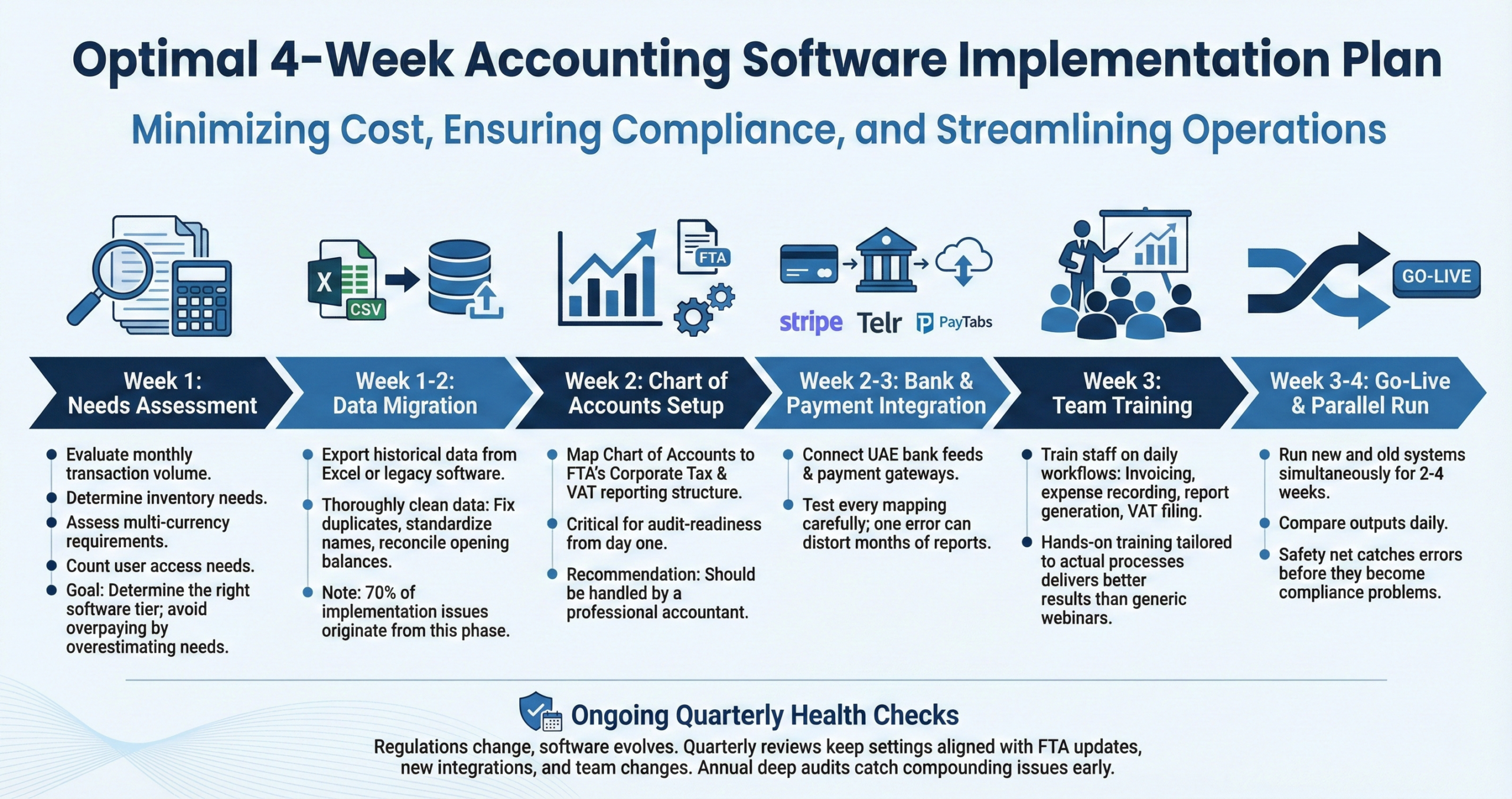
Based on our 250+ successful implementations, here’s the proven 7-step process most businesses follow:
- Week 1 (Needs Assessment): Evaluate monthly transaction volume, inventory needs, multi-currency requirements, and user count to determine the right software tier. Many businesses overpay by overestimating needs.
- Week 1-2 (Data Migration): Export historical data from Excel or legacy software. Clean it thoroughly — fix duplicates, standardize names, reconcile opening balances. This is where 70% of implementation issues originate.
- Week 2 (Chart of Accounts Setup): Map your chart of accounts to FTA’s Corporate Tax and VAT reporting structure. This critical step ensures audit-readiness from day one and should be handled by a professional accountant.
- Week 2-3 (Bank & Payment Integration): Connect UAE bank feeds and payment gateways (Stripe, Telr, PayTabs). Test every mapping carefully — one error can distort months of reports.
- Week 3 (Team Training): Train staff on daily workflows: invoicing, expense recording, report generation, and VAT filing. Hands-on training tailored to your actual processes delivers better results than generic webinars.
- Week 3-4 (Go-Live & Parallel Run): Run new and old systems simultaneously for 2-4 weeks, comparing outputs daily. This safety net catches errors before they become compliance problems.
- Ongoing (Quarterly Health Checks): Regulations change, software evolves. Quarterly reviews keep settings aligned with FTA updates, new integrations, and team changes. Annual deep audits catch compounding issues early.
Real Costs for a 10-Employee Dubai Business (2026)
| Item | Details | Cost |
|---|---|---|
| Zoho Books Professional | AED 250/month x 12 | AED 3,000/year |
| QuickBooks Plus | AED 350/month x 12 | AED 4,200/year |
| Implementation & Training (Zoho) | Data migration, setup, training | AED 3,500 |
| Implementation & Training (QuickBooks) | Data migration, setup, training | AED 5,000 |
| Light Outsourced Bookkeeping | VAT filing, reconciliation, reports | AED 999/month |
| Full Outsourced Package | Payroll, audits, CFO insights | AED 3,500–4,999/month |
| Total Year 1 (Software Only) | AED 6,500–9,200 | |
| Total Year 1 (Software + Light Outsourcing) | AED 18,500–21,000 |
Compare this to a full-time accountant at AED 96,000-144,000 annually. The ROI is undeniable.
Common Mistakes Dubai Businesses Make & How to Avoid Them
Mistake 1: Choosing the Cheapest Option Low-cost or free software (like Wave, GnuCash) lacks UAE-specific features. You’ll spend more fixing compliance issues later than you save upfront. Avoid unless you’re a 1-person freelancer with minimal transactions.
Mistake 2: Ignoring the Corporate Tax Module Some businesses pick software with “VAT support” but no Corporate Tax calculation features. When FTA asks for detailed tax schedules, you’re stuck with manual spreadsheets. Always verify Corporate Tax readiness.
Mistake 3: Poor Data Migration Rushing data import creates months of reconciliation headaches. Invest 2-3 days cleaning data before migration. One client skipped this, spent 40+ hours fixing errors, and delayed go-live by 6 weeks.
Mistake 4: No Local Support Offshore support teams don’t understand UAE regulations deeply. When you need urgent help before a VAT deadline, 24-hour ticket response times don’t cut it. Choose vendors with UAE-based partners (like ebs for Zoho).
Mistake 5: DIY Implementation Without Professional Setup Software is powerful if configured correctly. Most business owners lack time and expertise to optimize settings, map tax codes properly, or set up role-based permissions. Professional implementation (AED 2,000-5,000) pays for itself in error prevention.
When to Pair Software with Professional Accounting Services
Here’s the reality: Software handles data entry and calculations. It doesn’t handle strategic decisions, compliance interpretation, or audit defense.
You should add professional services if:
- You’re spending more than 10 hours/month on bookkeeping despite software
- You’re unsure if your VAT/Corporate Tax filings are 100% accurate
- You’ve received FTA queries or face an audit
- You need monthly financial insights, not just raw reports
- You’re planning fundraising, expansion, or sale (investors demand clean books)
At ebs, we offer complete accounting software implementation paired with ongoing outsourced bookkeeping. Our packages start at AED 999/month and include software optimization, monthly reconciliation, VAT filing, Corporate Tax preparation, and strategic CFO insights. You get software + expert execution in one package.
Think of it this way: Software is the car; professional accountants are the driver. You can own the best car, but without a skilled driver (especially in UAE’s complex regulatory terrain), you won’t reach your destination safely.
Conclusion
Choosing accounting software for your Dubai business in 2026 isn’t about price or popularity; it’s about meeting UAE compliance (5% VAT, 9% Corporate Tax, e-invoicing, WPS), scaling smoothly, and getting it right from day one. For most SMEs, Zoho Books offers the best mix of compliance, features, and value. QuickBooks stands out for brand and integrations. Xero fits modern startups. TallyPrime suits traditional traders. Odoo supports ERP-level growth.
The real advantage? Proper implementation with expert support.
As a Certified Advanced Zoho Partner with 250+ UAE implementations, ebs Chartered Accountants provides end-to-end support from software selection and setup to full outsourced bookkeeping packages starting at AED 999/month. Visit our Zoho Books implementation page to explore packages, or Contact us for a free 30-minute consultation where we’ll assess your needs and recommend the perfect solution.
Compliance simplified. Growth accelerated.
FAQs
Which accounting software is FTA approved in UAE 2026?
Most major software (Zoho Books, QuickBooks, Xero, Wafeq, Odoo) are “FTA-compliant,” meaning they generate VAT returns and Corporate Tax reports in formats FTA accepts. However, “FTA-approved auditor” is a designation for firms, not software. Choose software explicitly stating UAE VAT and Corporate Tax compliance.
How much does Zoho Books implementation cost in Dubai?
Professional implementation ranges from AED 2,000-5,000 depending on complexity (number of users, data migration volume, custom workflows). This includes chart of accounts setup for FTA compliance, bank integration, and user training. DIY setup is possible but risky for compliance.
Can I switch from Tally to Zoho Books?
Yes. Data migration takes 1-2 weeks. Export your Tally data (ledgers, invoices, inventory), clean it, and import into Zoho Books. Professional migration services (AED 2,500-4,000) ensure opening balances reconcile perfectly and no data is lost.
Does the software handle 9% Corporate Tax automatically?
Software like Zoho Books, QuickBooks, and Xero calculate Corporate Tax liabilities based on your profit/loss, apply the 9% rate, and generate tax schedules. However, complex scenarios (transfer pricing, related-party transactions, safe harbour rules) still require accountant review. Software automates calculations; accountants ensure strategic compliance.
Which accounting software supports Arabic invoices in UAE?
Zoho Books, TallyPrime, Wafeq, and Odoo offer full Arabic interfaces and invoices. QuickBooks and Xero have partial Arabic support (invoices but limited UI translation). If your clients or staff require Arabic documents, prioritize Zoho or Wafeq.
What are hidden costs in accounting software?
Watch for: additional user fees (most software charges per user after 1-3), transaction limits on lower tiers (upgrade fees if you exceed), premium support costs, third-party app subscription fees (payroll, CRM integrations), and annual price increases (typically 5-10% per year).
How long does implementation take for a Dubai SME?
4-6 weeks for most 5-20 employee businesses. Week 1: assessment and data prep. Week 2-3: migration and setup. Week 3-4: training and parallel run. Larger companies (50+ employees) may need 8-12 weeks.
Can the software integrate with UAE banks like Emirates NBD?
Yes. Zoho Books, QuickBooks, and Xero integrate with Emirates NBD, Mashreq, ADCB, FAB, and other major UAE banks via direct feeds or through aggregators like Plaid/Yodlee. Bank feeds automatically import transactions daily, cutting reconciliation time by 80%.
Do I need separate payroll software or is it included?
Most accounting software includes basic payroll (salary calculations, pay slips). However, UAE’s WPS compliance, end-of-service gratuity calculations, and multi-nationality complexities often require dedicated payroll modules (Zoho Payroll, QuickBooks Payroll add-on) or outsourced payroll services. Budget AED 50-150/employee/month for full payroll management.
What happens if I outgrow my current software?
Switching later is painful (data migration, retraining, compliance gaps). Choose scalable software from the start. Zoho Books, QuickBooks, and Odoo scale from 5 to 100+ employees with higher-tier plans. Avoid ultra-basic tools like Wafeq or free options if you plan to hire 20+ employees within 2 years.
Is cloud software safe for sensitive financial data in UAE?
Reputable vendors (Zoho, QuickBooks, Xero) use bank-level encryption (256-bit SSL), daily backups, and comply with international security standards (ISO 27001, SOC 2). For extra peace of mind, choose vendors with UAE data centers (Zoho offers this). Always enable two-factor authentication and restrict user permissions by role.
How often should I update my accounting software settings?
Quarterly reviews minimum. Check for: regulation changes (FTA updates), new integrations available, software feature releases, chart of accounts optimization, user permission updates as team changes. Annual deep audits (ideally with professional accountants) catch issues before they compound.