

The implementation of e-invoicing in the United Arab Emirates will be mandatory for organizations within the UAE starting in July 2026. The rules will be introduced in 2024 and 2025 to provide a comfortable infection facility in collaboration with the Ministry of Finance (MOF). First, this requirement will be related to business-to-business (B2B) and business-to-government (B2G) transactions, including both domestic and international activities.

What is e-invoicing?
e-invoicing is the procedure in which a supplier presents a digital invoice containing JSON or XML in a standardized, machine-elective layout to a customer. These invoices should follow accurate technical requirements such as Pint (PEPPOL invoice standard) or UBL (Universal Business Language) and PEPPOL network are transmitted through recognized service providers (ASPS). The UAE Federal Tax Authority (FTA) e-invoicing system gets these challans in real time through the provider’s ASP. Importantly, challans in formats such as PDF, PNG, or JPG will not be accepted as a valid e-invoice.
Benefits of e-invoicing within the UAE
The UAE government’s move to e-invoicing aims is to:
- Reduce VAT leakage: Real-time data transmission to the tax government lowers the threat of tax evasion.
- Cut invoice-processing costs: By disposing of paper invoices, organizations save on storage and administrative expenses.
- Increase compliance: e-invoicing complements transparency and decreases fraud.
- Support digitization: It aligns with the UAE’s broader digital-economic system goals, enhancing competitiveness globally.
The UAE e-invoicing “Five Corner” Model
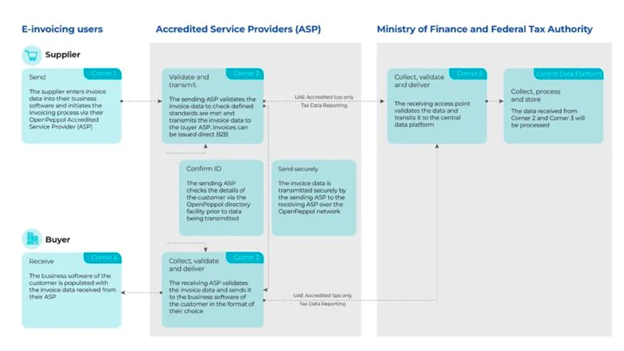
The UAE will adopt the Decentralized Continuous Transaction Control and Exchange (DCTCE) version, additionally referred to as the Peppol Five-corner Model. This entails 5 key steps:
- Corner1: The supplier sends an invoice through their ASP.
- Corner2: The supplier’s ASP validates and forwards the invoice to the buyer’s ASP.
- Corner3: The buyer’s ASP validates and sends the invoice to the customer.
- Corner4: The buyer gets the invoice in their business software program.
- Corner5: The supplier’s ASP concurrently sends the invoice information to the FTA in real time.
UAE e-invoicing requirements: Timeline for Implementation
| Year | Milestones |
| 2024 | Accreditation of service-provider companies begins. |
| 2025 | Additional rules and guidance will be introduced. |
| 2026 | e-invoicing will become obligatory for all B2B and B2G transactions |
Impact on UAE SMEs
Small and medium-sized businesses (SMEs) will gain significantly:
- Automation improves VAT compliance.
- Faster invoice validation complements cash-flow.
- Digitally saved information allows higher monetary analysis.
- Electronic storage reduces safety risks.
- Minimizes mistakes and overdue submissions.
How Businesses Can Prepare
- Start Early: Learn from GCC neighbors like Saudi Arabia, which applied e-invoicing in 2021.
- Choose an ASP: Select an accredited service provider that suits business needs.
- Train Employees: Conduct workshops to familiarize a staff of workers with the brand-new system.
- Review systems: Ensure the present invoicing software program is compatible with e-invoicing requirements.
Case Study: How a UAE SME Successfully Transitioned to e-invoicing
Company:a mid-sized wholesale distributor in Dubai.
Challenge:The Company has relied on the usage of conventional paper and PDF invoices, which results in delays in VAT reporting and low compliance problems.
Preparation Steps:
- Early in 2025, The Company control management has researched the UAE e-invoicing mandate and studied the Saudi Arabian rollout.
- They partnered with an ASP authorized by the UAE Ministry of Finance to combine e-invoicing into their ERP machine.
- The finance group underwent education periods to apprehend the Peppol five-corner model and the technical requirements of e-invoices.
- IT carried out a machine audit and upgraded their invoicing software program to generate XML invoices compliant with UAE requirements.
Implementation:
- By mid-2026, the company started issuing e-invoices for all B2B and B2G transactions.
- The ASP tested invoices and transmitted them to consumers and the FTA in real time.
- The finance group observed a sizable discount in invoice processing time and VAT reconciliation mistakes.
Results:
- Improved VAT compliance and decreased threat of penalties.
- Enhanced coins glide because of quicker invoice validation and fee cycles.
- Streamlined audit techniques with virtual invoice garage.
- Positive remarks from clients appreciating the quicker and more obviously great invoicing manner.
This case exemplifies how early preparation, engaging with the right technology partner can educate staff could make the transition to obligatory e-invoicing seamless and useful for UAE organizations.
Final Thoughts
e-invoicing within the UAE represents a transformative shift in the direction of a more obvious, efficient, and digitized business environment. By adopting the Peppol five-corner Model and mandating established digital invoices, the UAE government aims is to enhance VAT compliance, lessen fraud, and aid the country’s virtual economic system. By engaging with ebs chartered accountants, businesses can comply with compulsory e-invoicing requirements by providing a fully integrated, paperless invoicing solution to businesses, which automatically ensures Federal Tax Authority real-time reporting.
FAQs
Does e-invoicing become mandatory in UAE?
e-invoicing in UAE becomes mandatory for B2B and B2G transactions starting from July 2026.
Who takes care of e-invoicing compliance in UAE?
The UAE Federal Tax Authority (FTA) controls and monitors e-invoicing compliance.
What formats are accepted for e-invoices in UAE?
Only machine-elective formats such as XML or JSON are accepted; PDF and images are not valid.
How to prepare business for e-invoice in UAE?
Companies should select a recognized ASP, upgrade invoicing systems and train staff before 2026.